Decentralized kyc vaults limits to account for
Decentralized KYC (dKYC) vaults solve a fundamental infrastructure problem: how to verify identity without storing sensitive personal information in centralized databases. Instead of handing over a passport copy to a server, users hold their verified credentials in a self-sovereign vault. Verification agents then check these credentials locally, returning only a "verified" signal to the application. This architecture shifts data ownership from companies back to users, eliminating the risk of mass data breaches exposing PII.
The constraint lies in balancing this privacy with regulatory compliance. While platforms like Uniswap and PancakeSwap operate without mandatory ID verification, institutional and regulated DeFi protocols require proof of identity. dKYC vaults enable these protocols to satisfy compliance requirements—such as AML and CFT regulations—without creating a single point of failure for user data. The vault acts as a neutral substrate, ensuring that sensitive documents never leave the user’s control while still providing the necessary attestations for on-chain or off-chain services.
Implementing this system requires choosing the right verification agents and vault standards. Solutions like Zyphe pair AI verification agents with privacy-first substrates to automate the process securely. However, the complexity of integrating these vaults into existing Web3 interfaces remains a significant technical hurdle for many developers. Success depends on selecting tools that support standard decentralized identity protocols while maintaining a seamless user experience.
Decentralized kyc vaults choices that change the plan
Choosing a decentralized KYC vault requires balancing privacy, compliance, and user friction. Unlike traditional centralized databases, these vaults store personally identifiable information (PII) in user-controlled containers, releasing only verified claims to institutions. This architecture reduces institutional liability but introduces new operational complexities. You must evaluate how each solution handles data sovereignty, regulatory alignment, and integration costs.
The following comparison breaks down the primary tradeoffs across four distinct approaches to decentralized identity verification.
| Approach | Data Control | Compliance Risk | User Friction | Integration Cost |
|---|
Choose the next step
Building a decentralized KYC vault requires moving from abstract compliance goals to concrete technical and operational decisions. The landscape is shifting from centralized data hoarding to user-owned verification, but the implementation details vary significantly by use case. Whether you are integrating with a DeFi protocol or building a standalone identity layer, the following steps outline the critical choices you need to make.
Determine exactly what data points are required. For basic DeFi onboarding, a simple proof-of-personhood or wallet age check may suffice. For regulated institutional access, you will need full identity document verification and sanctions screening. Narrowing the scope reduces the attack surface and storage costs within the vault.
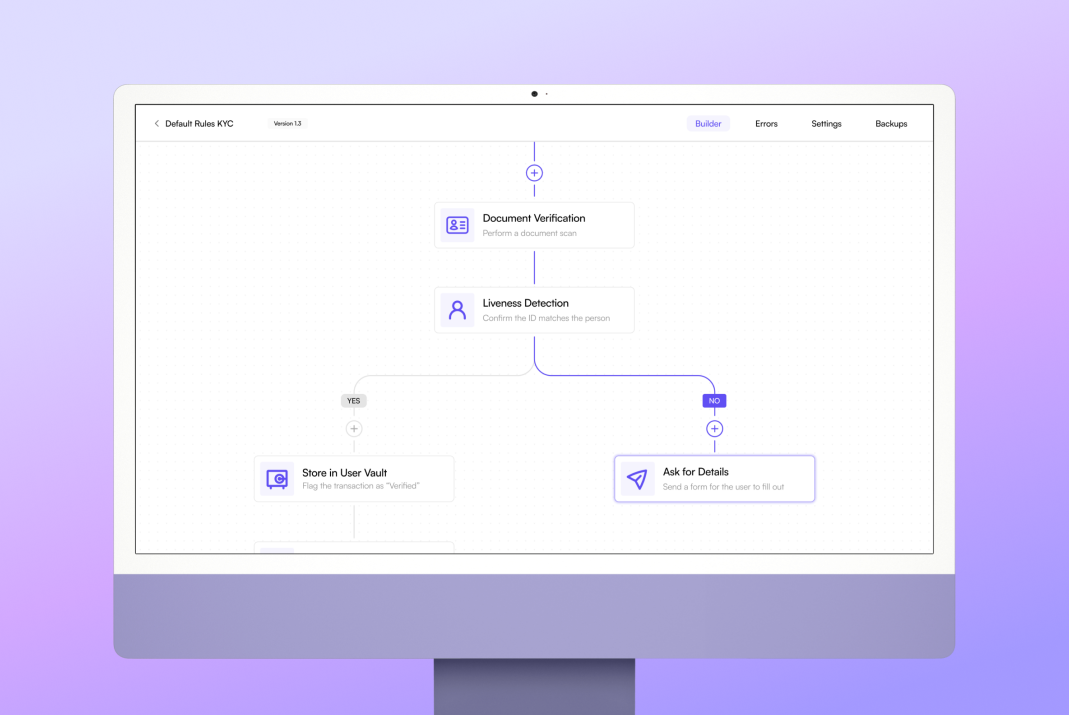
Choose the underlying infrastructure for storing and verifying credentials. Options range from self-sovereign identity (SSI) frameworks using Verifiable Credentials to AI-agent-driven verification systems that process data without storing raw PII. Evaluate these based on their interoperability with existing Web3 wallets and the privacy guarantees they offer to the user.
Connect your vault to real-time compliance engines. Even with decentralized storage, you need to check against global sanctions lists and politically exposed person (PEP) databases. Ensure your integration supports dynamic updates so that a user’s status remains current without requiring them to re-verify their identity from scratch.



As an Amazon Associate, we may earn from qualifying purchases.
| Approach | User Privacy | Regulatory Fit | Complexity |
|---|---|---|---|
| Self-Sovereign Identity (SSI) | High | Medium | High |
| AI-Agent Verification | High | High | Medium |
| Centralized Vault Proxy | Low | High | Low |
Spotting Weak Options and Misleading Claims
Decentralized KYC promises a balance between regulatory compliance and user privacy, but the current market is littered with platforms that overpromise on data sovereignty. Before integrating a solution, you need to separate genuine cryptographic proof from simple database shuffling. Many providers claim "decentralization" while still holding the decryption keys to your personal information in a centralized server. This creates a false sense of security where you are merely the custodian of your own data, not its true owner.
A common trap is the "no-KYC" myth surrounding decentralized exchanges. While platforms like Uniswap or PancakeSwap do not require identity verification for trading, this does not mean they are compliant with anti-money laundering (AML) laws. Regulatory pressure is increasing, and many protocols are quietly integrating on-chain screening tools. Relying on these platforms for high-volume or institutional activity without understanding their evolving compliance posture is a significant legal risk.
When evaluating tools, look for specific technical indicators of true decentralization. Does the solution use zero-knowledge proofs to verify age or residency without revealing the underlying data? If a platform requires you to upload a passport to a central portal, it is not a decentralized vault. Stick to providers that explicitly document their cryptographic architecture and offer clear, auditable proof that your biometric data never leaves your device or is stored in plain text on a third-party server.
Decentralized kyc vaults: frequently asked: what to check next
Do decentralized exchanges require KYC?
Most decentralized exchanges (DEXs) like Uniswap operate without mandatory identity verification, allowing users to trade directly from their wallets. However, this "no-KYC" model is shifting as regulators increase scrutiny. While the protocol itself may not check your ID, many front-end interfaces or bridges connecting to centralized liquidity pools might impose checks. If regulatory compliance is a priority for your operation, relying solely on a DEX for large-scale institutional flows carries legal risk.
How do decentralized KYC vaults differ from traditional databases?
Traditional KYC stores personal identifiable information (PII) in centralized servers, creating a single point of failure for hackers. Decentralized KYC vaults, such as those offered by Zyphe, shift ownership of this data to the user. Instead of uploading your passport to a company, you store it in a secure, user-controlled vault. Verification agents then access only the specific data points needed for compliance, minimizing exposure and eliminating redundant data collection.
Can I reuse my KYC verification across different platforms?
Yes, this is the primary utility of decentralized identity (DID) systems. Once you verify your identity through a trusted issuer and store the credential in your vault, you can grant temporary access to multiple platforms. This prevents the "KYC fatigue" common in Web3, where users must submit documents to every new exchange or DeFi protocol. Dock Labs and other DID providers enable this portability, allowing a single verification to satisfy compliance requirements across the ecosystem.
Are decentralized KYC solutions legally compliant?
Decentralized KYC tools are designed to meet existing regulatory frameworks, including AML (Anti-Money Laundering) and GDPR requirements. They facilitate compliance by ensuring data minimization and user consent, which are core tenets of modern privacy laws. Institutions using these vaults, such as those managed by Intellect EU, can maintain a "golden copy" of client data while respecting user sovereignty. Always verify that your specific provider supports the regulatory jurisdictions in which you operate.
No comments yet. Be the first to share your thoughts!