The Limits of Decentralized KYC Vaults
Decentralized KYC vaults promise a cleaner architecture for Web3 compliance, but they are not a universal fix. The model shifts personal data from centralized company databases into user-owned vaults, allowing institutions to verify credentials without holding raw PII. This separation reduces the attack surface for large-scale data breaches, a common vulnerability in traditional onboarding flows.
However, the technology faces distinct constraints. First, network effects remain a hurdle. For a vault to be useful, multiple institutions must agree on the same verification standards and trust the same substrate. If a user’s data is siloed in a network that their target platform doesn’t support, the convenience vanishes. Second, the reliance on AI verification agents introduces new failure modes. While these agents can automate checks, they still require accurate, high-quality input data to function correctly.
Privacy is also more complex than a simple "on/off" switch. While vaults prevent bulk data harvesting, they do not necessarily hide a user’s identity from every node in the network. Regulatory bodies like the FATF still require clear audit trails for suspicious activity. This means vaults must balance user anonymity with the need for transparent, compliant reporting. The result is a system that is often more efficient for verified users but can introduce friction during the initial setup phase.
The value of a decentralized vault depends entirely on the ecosystem it serves. In mature networks with standardized protocols, they streamline recurring interactions. In fragmented markets, they may create additional steps for both the user and the compliance officer. Understanding these tradeoffs is essential before adopting vault-based infrastructure.
Decentralized kyc vaults choices that change the plan
Adopting decentralized kyc vaults requires balancing user privacy against operational friction and regulatory scrutiny. While these vaults shift credential storage from centralized company databases to user-owned substrates, they introduce new complexities in verification speed and data synchronization. Platforms must evaluate how these tradeoffs impact their specific compliance workflows and customer experience.
| Feature | Traditional KYC | Decentralized KYC Vault |
|---|---|---|
| Data Storage | Centralized company servers | User-owned distributed vaults |
| Privacy Control | Institution holds full PII | User grants selective access |
| Verification Speed | Immediate (on-file) | Variable (on-demand retrieval) |
| Duplicate Risk | High across institutions | Low (single golden copy) |
| Regulatory Liability | Institution bears full burden | Shared or shifted to user |
The primary advantage lies in data minimization. By eliminating the need for each institution to store raw personally identifiable information (PII), the attack surface for data breaches shrinks significantly. Users retain ownership of their credentials, granting access only when necessary. This approach aligns with emerging privacy regulations that favor data localization and user consent over institutional hoarding.
However, this model introduces latency. Verification is no longer an instant lookup but a dynamic process requiring user interaction to unlock vault data. For high-frequency trading platforms or instant onboarding scenarios, this friction can increase drop-off rates. Additionally, the "golden copy" concept, where a single verified record syncs across a network, relies on robust interoperability standards that are still maturing in the Web3 space.
Regulatory liability also shifts. In traditional models, the institution is fully liable for data breaches. In decentralized vaults, liability may be shared or shifted depending on who controls the verification agent and the smart contract logic. Platforms must ensure their implementation meets local anti-money laundering (AML) requirements without compromising the privacy guarantees that make vaults attractive in the first place.
| Metric | Centralized | Decentralized Vault |
|---|---|---|
| Security Risk | Single point of failure | Distributed, harder to breach |
| User Experience | Fast, seamless | Requires user interaction |
| Compliance Cost | High storage & audit | Higher integration complexity |
Ultimately, the decision hinges on whether your platform prioritizes frictionless onboarding or long-term privacy resilience. Decentralized kyc vaults offer a superior privacy architecture but demand more sophisticated engineering and user education to manage the verification tradeoffs effectively.
How to Choose a Decentralized KYC Vault
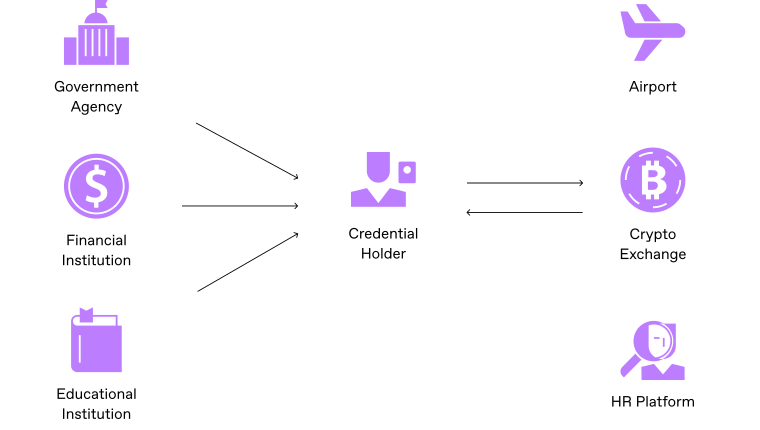
Decentralized KYC shifts identity verification from centralized company databases into user-owned vaults, eliminating the need for repeated PII submissions. This architecture pairs AI verification agents with cryptographic storage, ensuring that institutions receive only what they are authorized to see.
When selecting a vault solution, prioritize the following criteria to balance regulatory compliance with genuine user privacy.
The vault must give users granular control over who accesses their credentials. Look for solutions that allow selective disclosure, where you can share only specific data points (like age or residency) rather than uploading entire identity documents. This ensures your "golden copy" of identity remains under your command, not the platform's.
Compliance is the primary reason for adoption. Ensure the vault provider supports major regulatory frameworks, such as the EU’s eIDAS 2.0 or FATF Travel Rule standards. The solution should facilitate automatic syncing of verified data across institutions, preventing duplicate onboarding while maintaining a single, up-to-date record of your identity status.
A vault is only useful if it works across multiple platforms. Choose a system that integrates with various KYC providers and blockchain networks. This prevents vendor lock-in and allows you to use one verified identity across different DeFi protocols, exchanges, and service providers without re-verifying.
Since these vaults hold sensitive identity data, the underlying security must be robust. Look for zero-knowledge proof implementations and decentralized storage solutions that do not rely on a single point of failure. The system should expose data access via secure REST APIs, ensuring that verification requests are authenticated and encrypted.
Choosing the right decentralized KYC vault requires balancing strict compliance needs with the promise of true digital sovereignty. By focusing on user control, regulatory support, and technical security, you can select a solution that protects your identity without sacrificing ease of use.
Spotting Weak Options in Decentralized KYC
Decentralized KYC promises to move personal data from company databases into user-owned vaults, but the market is flooded with misleading claims. Many platforms still rely on centralized storage despite marketing themselves as decentralized. Always verify if the vault is truly user-controlled or just a rebranded database.
1. Centralized Backends Disguised as Decentralized
Some providers use blockchain only for identity proofs while storing actual PII in traditional SQL databases. This defeats the purpose of privacy. Check the architecture docs to see if data is encrypted and stored off-chain with only hashes on-chain.
2. Weak Verification Standards
Not all AI verification agents are equal. Some platforms accept low-confidence matches, increasing fraud risk. Look for providers that integrate with official identity sources like Socure or Zyphe, which use advanced AI to ensure a single, golden copy of each client’s data.
3. Lack of Interoperability
Many vaults are siloed, meaning a KYC check at one platform doesn’t transfer to another. True decentralized KYC should allow seamless data sync across institutions, ensuring data stays up-to-date without redundant checks. Choose platforms that support cross-network data sharing.
4. Poor Data Governance
Even with vaults, unclear data retention policies can lead to compliance breaches. Ensure the provider offers transparent governance, allowing users to delete or update their data easily. This is critical for GDPR and other privacy regulations.
Decentralized kyc vaults: frequently asked: what to check next
Understanding how decentralized identity shifts control from institutions to users is essential for navigating modern compliance. These systems use cryptographic proofs to verify identity without exposing raw personal data, addressing both privacy concerns and regulatory requirements.
No comments yet. Be the first to share your thoughts!