What decentralized KYC vaults actually do
Decentralized KYC vaults solve a specific infrastructure problem: how institutions verify identity without holding the raw personal data. Traditional centralized databases store Personally Identifiable Information (PII) on the institution’s own servers, creating a single point of failure and a massive liability target for hackers. Vaults flip this model by keeping the sensitive data off-chain and encrypted, while storing only cryptographic verification proofs on the blockchain.
The mechanism relies on a clear separation of concerns. When a user submits their identity documents, the data is encrypted and stored in a secure, off-chain location—often managed by a trusted node or decentralized storage network. The blockchain then records a zero-knowledge proof or a hash that confirms the user passed the KYC check. Institutions can query this proof to verify compliance without ever accessing the underlying name, address, or passport details.
This architecture shifts the risk profile significantly. As noted by infrastructure providers like Zyphe, this approach keeps personal data off institutional servers and out of their liability lists. It ensures that even if a bank or exchange is breached, the attacker finds no usable PII to steal. The vault acts as a cryptographic gatekeeper, validating identity once and allowing multiple institutions to trust the result without duplicating the data storage burden.
By decoupling verification from storage, decentralized KYC vaults enable a "golden copy" of client data. This prevents the fragmentation and duplication common in traditional onboarding, where each institution maintains its own isolated, potentially outdated records. The result is a more efficient compliance layer that prioritizes user sovereignty and institutional security simultaneously.
The Infrastructure Stack
Decentralized KYC relies on a layered architecture that separates identity verification from data storage. The goal is to ensure that personally identifiable information (PII) never resides on a central server, thereby reducing liability and aligning with strict data residency requirements like GDPR and CCPA.
Storage and Zero-Knowledge Proofs
The core mechanism involves storing encrypted user data on decentralized storage networks like IPFS or Arweave. Instead of transmitting raw documents, the system uses zero-knowledge proofs (ZKPs) to verify compliance. A ZKP allows a user to prove they meet specific criteria (e.g., age, jurisdiction) without revealing the underlying data. This cryptographic approach ensures that the "golden copy" of identity data remains with the user or in a secure, distributed vault, while institutions only receive the verified proof.
Compliance and Data Residency
Data residency rules require that certain information stays within specific geographic or legal boundaries. Decentralized vaults address this by allowing users to select storage nodes that comply with their local regulations. For instance, a European user can ensure their data is stored on nodes located within the EU. This granular control over data location helps institutions avoid regulatory penalties while maintaining a secure, auditable record of compliance.

Verification Layer
The verification layer sits between the storage network and the end user. It processes the zero-knowledge proofs and validates them against the institution's requirements. This layer is often implemented as a smart contract or a decentralized oracle network, ensuring that the verification process is transparent and tamper-proof. By keeping the verification logic on-chain or in a decentralized environment, the system maintains trust without relying on a single point of failure.
The shift from centralized providers to decentralized infrastructure
The KYC market is undergoing a structural change as institutions move away from siloed, centralized data silos toward shared decentralized infrastructure. This transition addresses the primary friction points of legacy systems: redundant verification costs, fragmented user experiences, and the escalating liability of maintaining centralized honeypots of sensitive identity data.
Centralized KYC providers operate on a traditional model where each institution stores its own copy of user data. This creates a "whack-a-mole" scenario for compliance teams, as data must be manually synced or re-verified across partners. In contrast, decentralized KYC vaults enable institutions to sync data and documents, guaranteeing a single, golden copy of each client and associated natural persons. Whenever a client is onboarded or their data is updated at any institution within the network, the vault ensures data is kept up-to-date while eradicating duplicates 1.
This architectural shift fundamentally alters the risk profile for financial institutions. By moving identity verification to a decentralized layer, liability for data breaches shifts from the individual institution to the cryptographic integrity of the vault network. This reduces the attack surface and simplifies regulatory reporting, as auditors can verify the integrity of the verification process without needing access to the raw, sensitive PII stored in the vault.
Comparison: Centralized vs. Decentralized KYC
The table below contrasts the operational and security implications of traditional centralized KYC against emerging decentralized vault infrastructure.
| Metric | Centralized KYC | Decentralized Vaults |
|---|---|---|
| Data Ownership | Institution holds raw PII | User holds key; institution holds proof |
| Breach Liability | High (direct custodian of data) | Low (zero-knowledge proofs only) |
| Integration Complexity | Low (API-based, siloed) | Medium (requires network onboarding) |
| Data Freshness | Static (requires re-verification) | Dynamic (auto-syncs across network) |
| Duplicate Handling | Manual reconciliation | Automatic (golden copy model) |
The move toward decentralized infrastructure is not just a technological upgrade but a regulatory necessity as data privacy laws like GDPR and CCPA tighten. Institutions that cling to centralized storage models face increasing compliance costs and reputational risks. The decentralized vault model offers a path to scalable, compliant onboarding that respects user privacy while satisfying regulatory requirements.
Compliance strategy for Web3 institutions
Institutions adopting decentralized KYC vaults must navigate a complex regulatory environment where data privacy and legal transparency intersect. The core challenge is maintaining a "golden copy" of client data that satisfies anti-money laundering (AML) requirements without exposing sensitive information to the broader network or third-party processors.
1. Establish Data Minimization Protocols
Begin by defining exactly which data points are necessary for compliance. Decentralized KYC allows you to store only the cryptographic proofs of identity rather than raw documents. This approach reduces your liability surface area. If a vault is compromised, attackers gain access to hashed proofs, not passport scans or home addresses. Align your data retention policies with the principle of least privilege, ensuring that only verified, essential attributes are ever written to the vault.
2. Integrate with Regulated Identity Providers
Your vault is only as compliant as the identity providers (IdPs) feeding it. Partner with vetted, regulated entities that perform the initial Know Your Customer (KYC) checks. These providers should issue verifiable credentials (VCs) that are cryptographically signed. This creates an auditable chain of custody. When a client interacts with your platform, you verify the signature against the IdP’s public key rather than storing the data yourself. This shifts the burden of initial verification to specialized, compliant infrastructure.
3. Implement Dynamic Access Controls
Regulatory requirements often change. Your infrastructure must support dynamic access controls that allow you to revoke or update permissions instantly. Use smart contracts to manage these permissions, ensuring that only authorized entities can view specific data subsets. For example, a law enforcement request should trigger a specific, time-bound access window for relevant data, while general users only see their own verified status. This granular control is critical for responding to subpoenas or regulatory audits without exposing unrelated client information.
4. Conduct Regular Security Audits
Decentralized systems are not immune to bugs. Schedule regular security audits of your vault’s smart contracts and integration layers. Focus on the logic that handles data encryption, key management, and access revocation. Ensure that your implementation of zero-knowledge proofs (if used) has been independently verified. These audits should be documented and made available to regulators as proof of your commitment to security. Treat your vault infrastructure with the same rigor as a traditional banking core system.
5. Maintain Transparent Audit Trails
Finally, ensure that every interaction with the vault is logged immutably. This includes data access requests, verification updates, and permission changes. These logs serve as your primary evidence during regulatory reviews. They demonstrate that you are not hiding data but managing it according to strict legal frameworks. Transparency in your audit trail builds trust with regulators, showing that your decentralized approach enhances, rather than obscures, compliance.
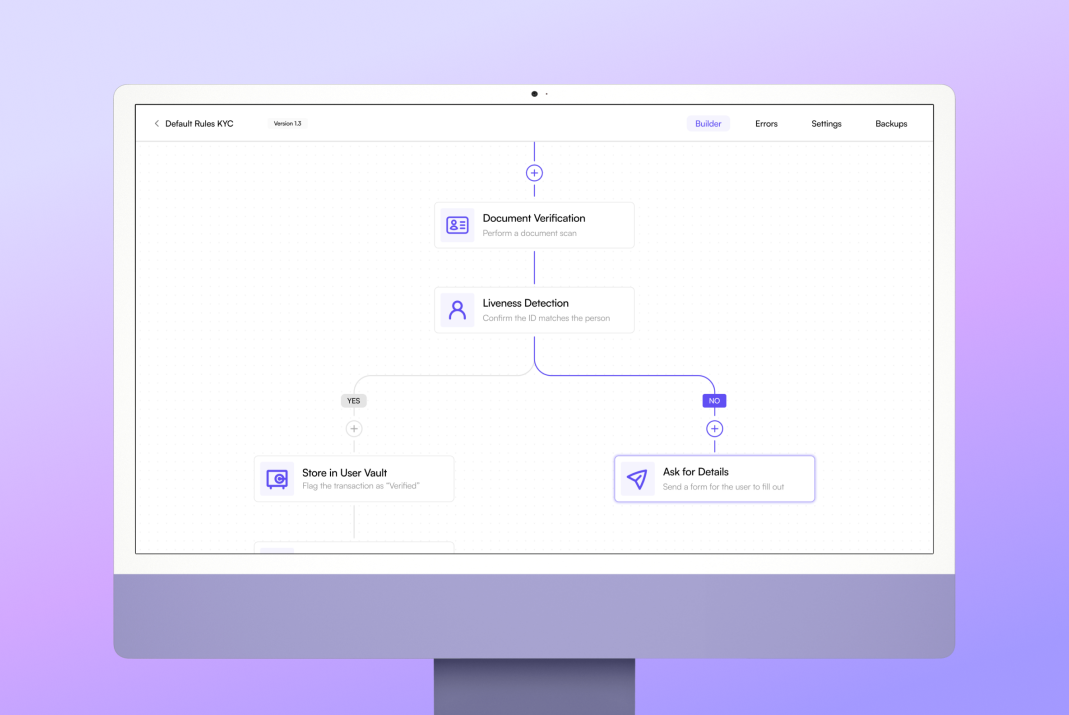
Identify minimal data points required for AML compliance. Store only cryptographic proofs, not raw documents, to reduce liability.
Partner with vetted identity providers to issue verifiable credentials. Verify signatures against public keys rather than storing raw data.
Use smart contracts for dynamic permissions. Ensure time-bound access for regulatory requests while keeping general data private.
Regularly test smart contracts and encryption logic. Document audits to prove security rigor to regulators.
Maintain immutable logs of all data access and updates. Use these trails to demonstrate compliance during regulatory reviews.
Decentralized Identity and Compliance FAQs
Decentralized KYC (dKYC) shifts identity verification from centralized databases to user-controlled digital vaults. Instead of institutions holding your raw documents, you store them securely and share cryptographic proofs of compliance. This architecture ensures a single, "golden copy" of client data that updates across the network without creating redundant copies at every service provider.
This model directly addresses the tension between regulatory mandates and user privacy. While many decentralized exchanges (DEXs) like Uniswap currently operate without mandatory ID verification, the infrastructure for compliant onboarding is rapidly maturing. dKYC allows these platforms to verify eligibility without ever accessing or storing the underlying personal identifiable information (PII).
No comments yet. Be the first to share your thoughts!