What decentralized KYC vaults actually do
Decentralized KYC vaults solve a specific friction point in Web3: the conflict between regulatory compliance and user privacy. Traditional KYC processes require you to upload sensitive documents—passports, utility bills, facial scans—to a centralized database managed by a service provider. This creates a high-value target for hackers and raises serious concerns about how your data is stored, shared, or sold.
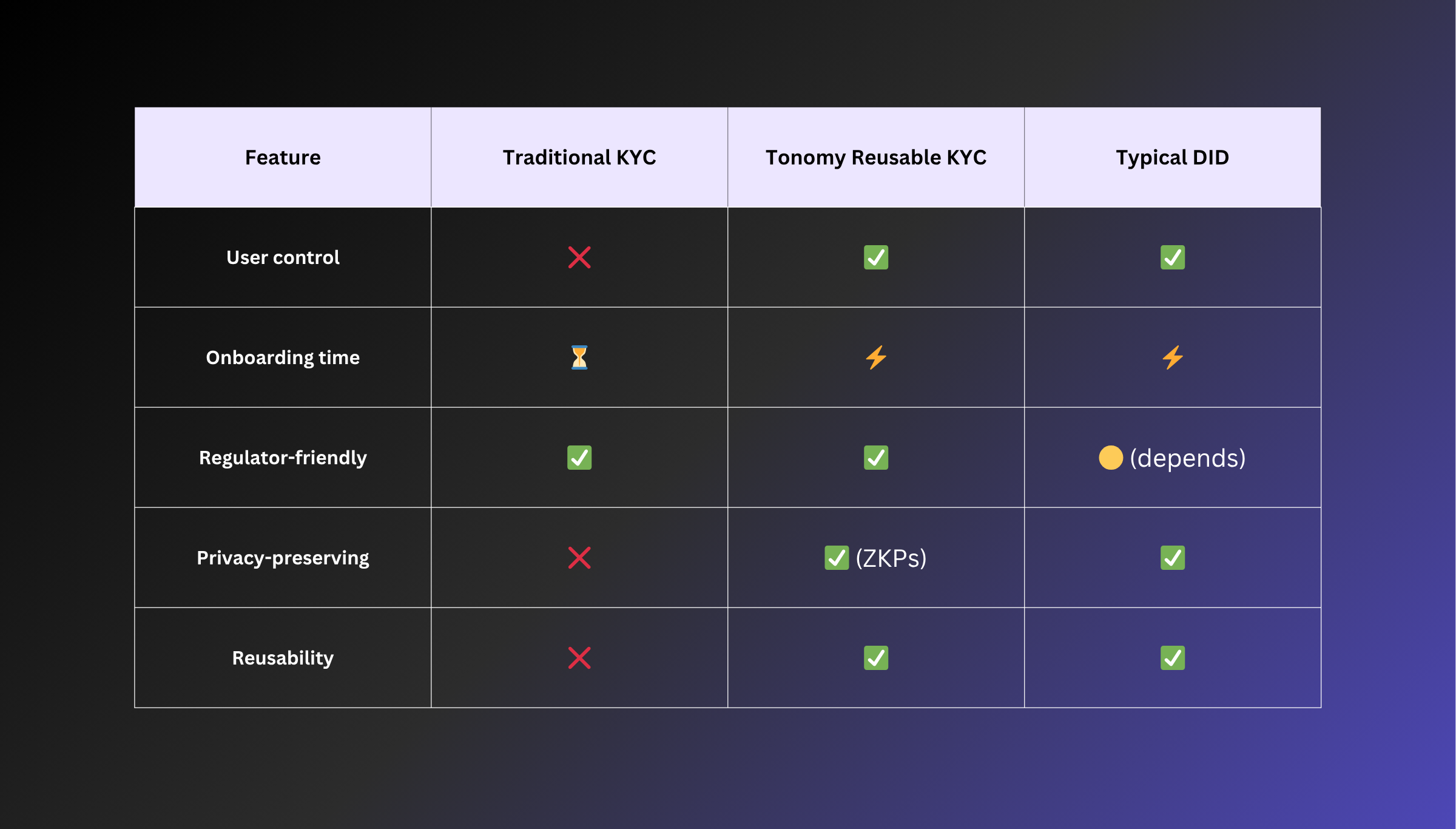
A decentralized KYC vault changes this model by separating the data from the verification. Your sensitive personal information remains stored off-chain, encrypted, and under your control. The "vault" acts as a secure repository, but it does not broadcast your data to the public blockchain. Instead, the system issues a verifiable credential—a digital token or proof—that sits on-chain. This credential confirms that you have passed the necessary checks (e.g., you are over 18, you are not on a sanctions list) without revealing the underlying details.
Think of it like a bouncer at a club. The bouncer checks your ID (the off-chain data) but only gives you a wristband (the on-chain credential) to enter. The bouncer doesn't need to memorize your address or birthdate, and the club staff don't need to see your ID to let you in; the wristband is sufficient proof. This architecture allows platforms to verify compliance while users retain ownership of their identity data.
This approach relies on decentralized identity standards, such as W3C Verifiable Credentials, to ensure that the on-chain proofs are standardized and interoperable. By keeping the raw data off-chain and the verification on-chain, decentralized KYC vaults aim to reduce the risk of large-scale data breaches while meeting the legal requirements of financial institutions and regulated platforms.
Infrastructure layers and data flow
A decentralized KYC vault operates as a secure bridge between traditional identity verification and on-chain anonymity. The architecture relies on three core components: Decentralized Identifiers (DIDs), Verifiable Credentials (VCs), and zero-knowledge proofs (ZKPs). Together, these elements allow a user to prove they meet specific criteria—such as being over 18 or located in a permitted jurisdiction—without exposing their underlying personal data.
The process begins with identity issuance. A trusted authority, such as a government agency or a regulated financial institution, issues a Verifiable Credential to the user’s digital wallet. This credential is cryptographically signed, ensuring its authenticity. The user then stores this credential locally, maintaining full control over their data. This is a fundamental shift from centralized databases, where your information is stored on a server owned by a third party.
When a service requires verification, the user does not send their ID card or passport. Instead, they generate a zero-knowledge proof. This cryptographic method allows the user to demonstrate that a statement is true without revealing the information itself. For example, a decentralized KYC vault can prove that a user’s age is greater than 18 without revealing their exact birthdate. The proof is verified on-chain, ensuring compliance while preserving privacy.
This flow minimizes the attack surface for data breaches. Since personal data remains off-chain and in the user’s possession, there is no central honeypot for hackers to target. The only data shared is the minimal proof required for compliance. This architecture is increasingly vital for Web3 applications seeking to integrate regulatory compliance without sacrificing user privacy.

The technical implementation often involves smart contracts that validate these proofs. These contracts act as the gatekeepers, allowing access only to users who present a valid ZKP. This ensures that the verification process is automated, transparent, and immutable. As the ecosystem matures, interoperability standards like W3C DID and VC specifications will play a crucial role in ensuring that credentials issued by one entity are accepted by another.
Comparing vault models and trust assumptions
When building a Decentralized KYC Vaults guide, the first architectural decision is how identity data moves from the user to the verifier. There is no single "correct" model; instead, there are trade-offs between speed, privacy, and trust. The three dominant approaches are centralized oracle models, fully decentralized networks, and hybrid architectures.
Centralized Oracle Models
In this setup, a single entity or consortium manages the verification process. Users submit documents to a known provider, who then issues a credential or token on-chain. This model is fast and familiar, leveraging existing legal frameworks and compliance infrastructure.
However, it reintroduces the central point of failure. If the oracle is compromised or acts maliciously, the entire vault system is at risk. It also creates a honeypot for data breaches, as sensitive identity documents are stored in one location. This model is best suited for early-stage DeFi protocols prioritizing rapid compliance over maximum decentralization.
Fully Decentralized Networks
Fully decentralized networks distribute the verification workload across a peer-to-peer mesh. No single entity holds the master key or the complete dataset. Verification is often achieved through zero-knowledge proofs or multi-party computation, ensuring that the verifier learns nothing about the underlying data.
This approach offers the highest level of privacy and censorship resistance. It aligns closely with the original ethos of DeFi. The trade-off is complexity and latency. Implementing these networks requires significant computational resources and can result in slower user onboarding experiences. It is ideal for high-value, privacy-sensitive applications where regulatory scrutiny is expected to be intense.
Hybrid Architectures
Hybrid models attempt to balance the two extremes. They might use a centralized entity for initial document collection but rely on decentralized networks for the final attestation or data storage. This can reduce the attack surface while maintaining a smoother user experience.
The risk here is ambiguity. If the hybrid model is not clearly defined, it may inherit the weaknesses of both systems without the benefits of either. It is crucial to audit the specific trust assumptions of any hybrid implementation. Is the centralized part truly optional? Is the decentralized part verifiable? Without clear answers, the vault may offer a false sense of security.
Side-by-Side Comparison
The table below summarizes the key differences between these implementation strategies for Decentralized KYC Vaults.
| Model | Trust Assumption | Privacy Level | Onboarding Speed |
|---|---|---|---|
| Centralized Oracle | High (Single Entity) | Low | Fast |
| Decentralized Network | Low (Distributed) | High | Slow |
| Hybrid | Medium | Medium | Medium |
The regulatory tightrope: GDPR, data residency, and legal uncertainty
The promise of a Decentralized KYC Vaults guide is to separate identity verification from centralized custody, but the legal reality is far more tangled. While blockchain offers transparency, it creates a permanent record of who verified whom. This immutability clashes directly with privacy laws like the GDPR, which grant individuals the right to have their data erased.
The core conflict lies in the "right to be forgotten." If a user’s identity proof is hashed on-chain, deleting the off-chain document doesn’t remove the cryptographic proof of existence. Regulators increasingly view this as a compliance failure. Vaults must carefully architect their data layers to ensure that sensitive personal information never touches the immutable ledger, relying instead on zero-knowledge proofs or off-chain storage with on-chain references.
Data residency adds another layer of complexity. Financial regulations often require that customer data remain within specific geographic borders. A decentralized network spanning multiple jurisdictions makes it difficult to guarantee that data processing complies with local laws. For a Decentralized KYC Vaults guide to be viable, it must address how nodes in different countries handle data requests and whether the architecture can enforce jurisdictional boundaries.
Regulatory uncertainty remains the highest risk. Laws are evolving slower than the technology, creating a gray area where compliance is subjective. Projects that prioritize decentralization often find themselves at odds with traditional financial regulators who demand clear points of accountability. Until clear frameworks emerge, users and providers must navigate these gaps carefully, understanding that legal exposure is high and precedent is scarce.
Institutional adoption of decentralized KYC vaults
Institutional capital is reshaping the DeFi landscape, but it arrives with strict compliance requirements that public, permissionless protocols often struggle to meet. This friction has accelerated the demand for structured access controls and KYC whitelisting within decentralized vaults. Unlike retail users who prioritize anonymity and ease of access, institutional players require predictable regulatory outcomes and audit trails.
The shift toward "institutional DeFi" is not merely about adding a layer of identity verification; it is about integrating governance mechanisms that align with traditional financial standards. A vault designed for institutional participation must balance decentralization with the ability to restrict access to verified entities. This structure allows institutions to deploy capital with confidence, knowing that counterparty risk is mitigated through pre-screened whitelisting.
As regulatory scrutiny increases, the architecture of these vaults is evolving to support granular permissions. This approach enables protocols to offer tailored investment products that comply with jurisdiction-specific laws without sacrificing the core benefits of on-chain transparency. The market is increasingly rewarding protocols that can demonstrate robust compliance frameworks, signaling a maturation of the DeFi sector.
Checklist for implementing KYC vaults
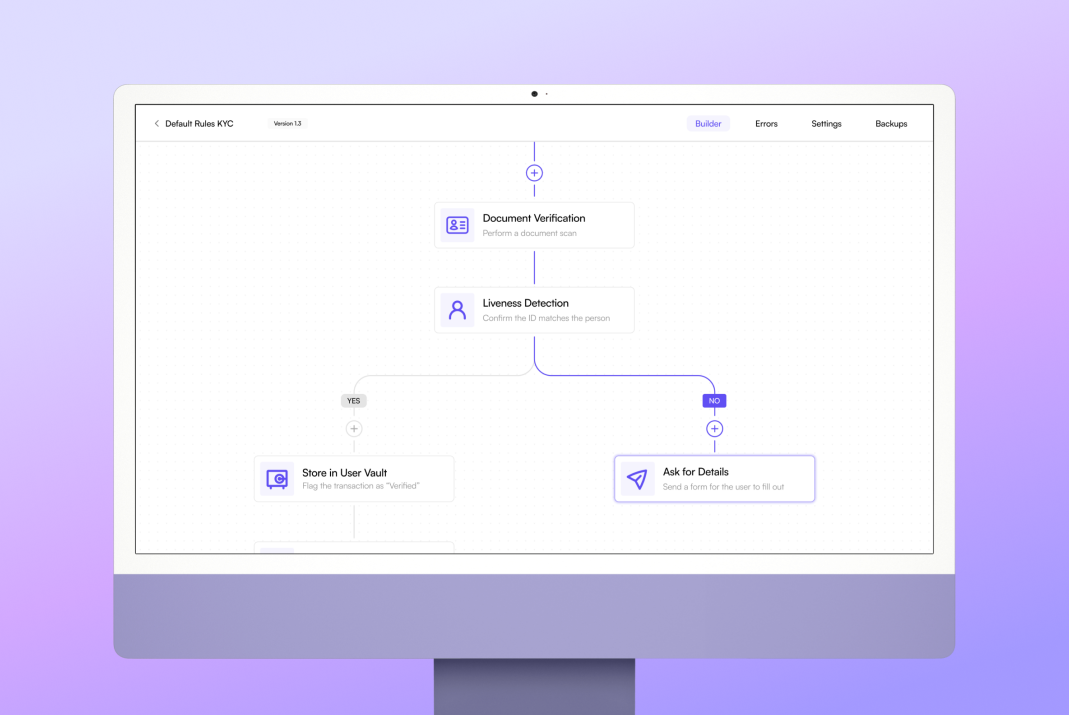
Deploying a decentralized KYC vault requires balancing regulatory mandates with the privacy promises of Web3. This workflow guides developers and compliance officers through the critical evaluation and deployment phases. Treat this checklist as a structural audit for your vault architecture.
By following these steps, you build a decentralized KYC vault that satisfies legal obligations without compromising user privacy. This approach ensures your platform remains compliant while maintaining the trust necessary for institutional DeFi participation.
Frequently asked questions about KYC vaults
Understanding how decentralized identity infrastructure handles sensitive personal data is critical for both compliance officers and developers. The following questions address the most common concerns regarding data retention, regulatory alignment, and cross-platform usability.
No comments yet. Be the first to share your thoughts!