What decentralized KYC vaults actually are
A decentralized KYC vault is a user-owned data store that holds identity documents and issues verifiable credentials. Instead of uploading passports or driver’s licenses to a company’s central server, you store encrypted files in your own digital wallet. When a business needs to verify your age or location, you grant them temporary access to a specific proof, not the raw data itself.
This model flips the traditional KYC structure. In the current system, every financial institution maintains its own siloed database of personally identifiable information (PII). If one company suffers a breach, your data is compromised everywhere. With a decentralized vault, your data stays under your control. You decide who sees it, what they see, and for how long.
The technology relies on verifiable credentials, a standard backed by the W3C. Think of a verifiable credential like a digital diploma. A university issues it, you hold it in your wallet, and a potential employer can verify its authenticity without contacting the university directly. Similarly, a government agency might issue a credential proving you are over 21. You present this credential to a bar or a crypto exchange, and they verify the signature instantly without storing your birthdate in their own records.
This approach eliminates the need for redundant data collection. As noted by industry providers like Zyphe, this architecture shifts personal data from company databases into user-owned vaults, eliminating the need for repeated submissions. When a client is onboarded at one institution within a network, that verified status can be shared with others, ensuring a single, golden copy of the client’s data while eradicating duplicates.
For legal and compliance teams, this shift requires a new understanding of liability. If your data is stolen from your own device, the liability differs significantly from a corporate data breach. However, the reduction in centralized attack surfaces offers a compelling argument for adoption. By minimizing the amount of sensitive data held by any single entity, decentralized KYC vaults reduce the potential impact of large-scale data leaks.
Why institutions are shifting to vault-based models
The traditional KYC process is broken for digital assets. Institutions currently treat every onboarding event as a fresh audit, forcing clients to submit the same passports and proof-of-address documents repeatedly. This redundancy is not just an operational drag; it is a security liability. Each time sensitive data is copied, stored, and transmitted, the attack surface expands. A vault-based model changes this dynamic by creating a single, encrypted "golden copy" of the client's identity that can be reused across multiple protocols.
Regulatory frameworks like MiCA and FATF guidance are accelerating this shift. Regulators are no longer just asking for compliance; they are demanding data integrity and auditability. Vaults allow institutions to prove compliance without exposing raw personal data to every counterparty. Instead of trusting a decentralized exchange with a full database of client records, a protocol can simply verify a cryptographic proof that the vault holder is verified. This aligns with the FATF's travel rule requirements while preserving the privacy principles of DeFi.
The economic incentive is equally strong. Redundant KYC checks drain resources. By adopting a shared vault standard, institutions can reduce operational costs and speed up client onboarding. According to industry analysis, decentralized identity models allow banks to share KYC information securely and cost-effectively, eliminating the need for duplicate data entry and verification cycles [Entrust]. This efficiency is critical as the volume of institutional crypto activity grows.
Leading decentralized KYC infrastructure providers
The infrastructure layer for decentralized KYC vaults is still maturing, but a few platforms have established clear architectural patterns. When evaluating a provider, the primary differentiator is how they handle the tension between regulatory compliance and user privacy. The best solutions do not merely digitize paper forms; they shift data ownership back to the user while giving institutions a reliable, verifiable proof of identity.
Zyphe: AI-driven verification agents
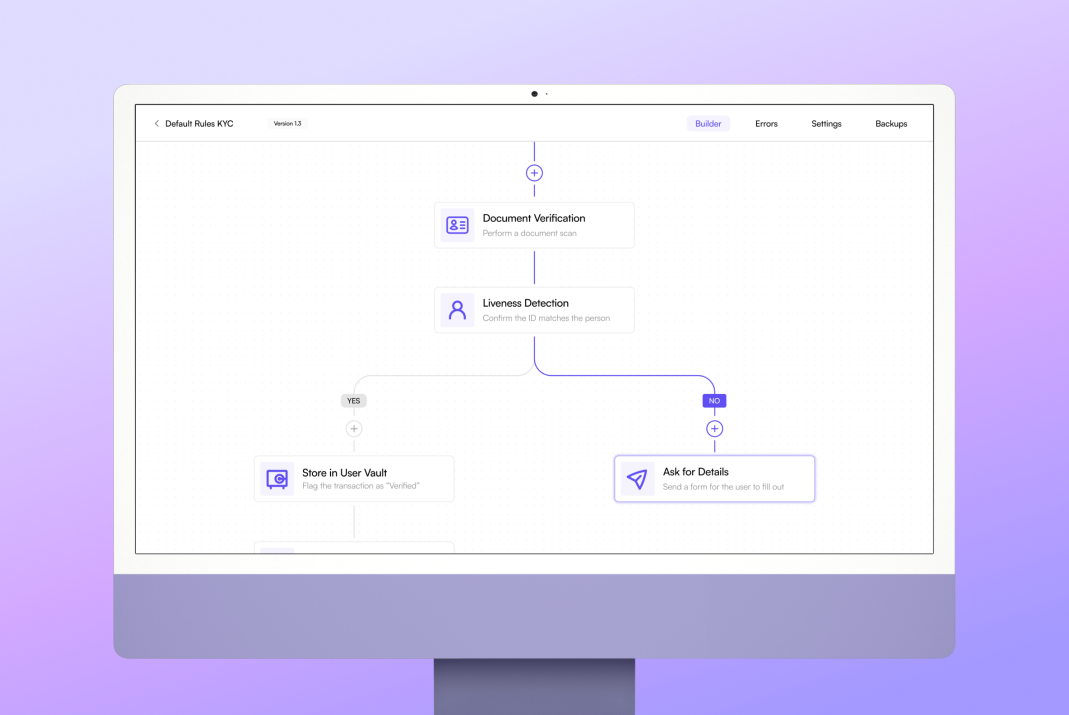
Zyphe takes a distinct approach by pairing AI verification agents with a privacy-first substrate. Instead of storing personal identifiable information (PII) in centralized databases, Zyphe shifts that data into user-owned vaults. This architecture eliminates the risk of large-scale data breaches because the institution never holds the raw data. The AI agents verify the credentials within the vault and return a simple pass/fail result to the verifier. This method is particularly effective for high-volume onboarding where speed and privacy are both critical.
Dock: W3C-compliant credential issuance
Dock Labs focuses heavily on standards compliance, building its infrastructure around W3C Verifiable Credentials. This makes it a strong choice for enterprises that need to integrate with existing legacy systems or require strict adherence to international digital identity standards. Dock provides the tools to issue, store, and verify credentials across different platforms. Its strength lies in its interoperability; it acts as a bridge between traditional identity frameworks and decentralized networks, ensuring that the KYC data remains portable and standardized.
Catalyst: Institutional-grade blockchain management
Catalyst, developed by Intellect.eu, is built for the financial services sector. It offers a comprehensive blockchain manager designed to handle the complexities of regulated industries. Catalyst enables institutions to sync data and documents across a network, guaranteeing a single, golden copy of each client. This is crucial for preventing duplicate onboarding and ensuring that KYC data remains up-to-date across all participating institutions. It is less about consumer-facing apps and more about backend infrastructure for banks and large financial entities.
Comparison of infrastructure approaches
The table below summarizes the core technical differences between these providers. Understanding these distinctions helps in selecting the right infrastructure for your specific compliance needs.
| Provider | Verification Method | Data Storage | Supported Blockchains |
|---|---|---|---|
| Zyphe | AI Agents | User-owned Vaults | Multi-chain |
| Dock | Verifiable Credentials | Decentralized Identifiers (DID) | Ethereum, Polygon, Hyperledger |
| Catalyst | Blockchain Manager | Permissioned Ledger | Hyperledger Fabric |
Compliance risks and regulatory gaps
Decentralized KYC vaults sit at the intersection of two incompatible legal philosophies: the immutable nature of blockchain and the fluid, revocable rights of modern privacy law. For institutions building a Decentralized KYC Vaults guide, this friction is not theoretical—it is the primary barrier to mainstream adoption. The core tension lies in how data is stored, verified, and, crucially, how it can be deleted.
The GDPR Erasure Conflict
The most significant regulatory hurdle is the conflict between blockchain immutability and the GDPR’s "right to be forgotten." If a user’s identity data is hashed and stored directly on-chain, it cannot be erased without breaking the chain’s integrity. This creates a legal liability for any protocol that attempts to store personal data on a public ledger.
To navigate this, most compliant vault architectures rely on zero-knowledge proofs (ZKPs). Instead of storing the ID itself, the vault stores a cryptographic proof that the ID is valid. If a user requests deletion, the off-chain data is destroyed, and the on-chain proof is invalidated or rotated. This approach allows institutions to satisfy AML requirements without permanently anchoring PII to the blockchain.
AML Monitoring Challenges
While GDPR focuses on data privacy, Anti-Money Laundering (AML) regulations focus on transaction monitoring. Decentralized exchanges (DEXs) often operate without KYC, creating blind spots for compliance teams. A decentralized KYC vault must bridge this gap by providing a "golden copy" of verified user status that multiple institutions can trust without sharing raw data.
The challenge is that AML monitoring is dynamic. A user’s risk profile can change overnight if their wallet interacts with a sanctioned entity. Static KYC checks are insufficient. Protocols must implement continuous monitoring, often through decentralized oracles that update risk scores in real-time. This requires a level of data integration that many legacy financial institutions are not yet prepared to handle.
Jurisdictional Variance
Regulatory expectations vary wildly across borders. The EU’s MiCA regulation imposes strict requirements on crypto-asset service providers, while the US relies on a patchwork of FinCEN guidelines and state-level laws. A decentralized KYC vault must be configurable to meet the specific requirements of each jurisdiction.
This means the vault cannot be a one-size-fits-all solution. It must allow for jurisdiction-specific data fields, retention periods, and verification standards. For example, a vault serving EU users must prioritize GDPR compliance, while one serving US users must align with the Bank Secrecy Act. This complexity increases development costs and operational overhead, making it difficult for smaller protocols to enter the space.
The path forward requires a standardized framework for decentralized identity that can adapt to these varying legal landscapes. Until then, institutions must carefully design their vaults to minimize liability while maximizing compliance. The technology is ready, but the legal clarity is still evolving.
Market outlook and adoption trends
The decentralized identity market is shifting from experimental pilot programs to institutional infrastructure. As regulatory frameworks solidify, the focus is moving beyond simple identity verification to comprehensive data synchronization. Decentralized KYC vaults enable institutions to maintain a single, golden copy of client data, ensuring that records remain up-to-date across the network without duplication.
This shift is driven by the convergence of DeFi and traditional finance. While many decentralized exchanges still operate without strict identity checks, the broader financial ecosystem is integrating decentralized identity protocols to meet compliance requirements. This integration allows for seamless data sharing between banks, fintechs, and crypto platforms, reducing onboarding friction while maintaining regulatory adherence.
Investment in decentralized identity infrastructure is reflecting this growing demand. The following chart illustrates the market activity for decentralized identity (DID) related tokens, serving as a proxy for the capital flowing into this sector.
Checklist for evaluating KYC vault solutions
Before integrating a vendor, run through this workflow to ensure the platform meets your compliance and technical requirements. The goal is to verify that the vault architecture actually protects user data while satisfying regulatory audits.
Confirm the solution supports GDPR, CCPA, and relevant AML directives. Ensure the vendor provides clear documentation on how data minimization and the right to erasure are handled within the decentralized structure.
Decentralized KYC oracles bridge traditional data with on-chain verification. Test the oracle’s uptime and accuracy by reviewing their historical performance logs and checking for any past security incidents or data leaks.
Simulate a full user journey. Check if the verification process is intuitive and if the vault correctly stores credentials without exposing PII to the integrating application. A clunky flow increases drop-off rates significantly.
Ensure the API is well-documented and supports standard protocols like W3C Verifiable Credentials. Poor documentation often leads to integration delays and security vulnerabilities during the development phase.
Always consult legal counsel before deploying a decentralized KYC solution, as regulatory interpretations vary by jurisdiction.
Frequently asked questions about decentralized KYC
What is decentralized KYC? Decentralized KYC shifts identity verification from centralized corporate databases into user-owned vaults. It allows institutions to sync data and documents, guaranteeing a single, golden copy of each client and associated natural persons. Whenever a client is onboarded or their data is updated at any institution within the network, the information stays consistent and up-to-date, effectively eradicating duplicates across the system.
Do decentralized exchanges have KYC? Many decentralized exchanges (DEXs) like Uniswap and PancakeSwap do not require ID verification. These no-KYC platforms often let users trade without registering or providing identification. This stands in contrast to centralized exchanges, which must comply with strict regulatory requirements to prevent money laundering and terrorist financing.
How does decentralized KYC protect privacy? By storing identity credentials in a decentralized vault, users retain control over their personal data. Instead of sharing raw documents with every institution, users can grant temporary, permission-based access to verified credentials. This minimizes the attack surface for data breaches and reduces the risk of identity theft associated with large, centralized repositories.
Is decentralized KYC legally compliant? Yes, when implemented correctly, decentralized KYC can meet regulatory standards. The goal is to verify identity without storing unnecessary personally identifiable information (PII) on centralized servers. Institutions can still perform the required due diligence by verifying the cryptographic proofs of identity held in the user's vault, ensuring compliance with anti-money laundering (AML) laws while respecting user privacy.
No comments yet. Be the first to share your thoughts!