What decentralized KYC vaults actually do
Decentralized KYC vaults shift the burden of personally identifiable information (PII) storage from centralized institutional servers to user-held cryptographic containers. In this model, the institution no longer hoards raw data; instead, it verifies cryptographic proofs or receives permissioned access to specific data points without ever holding the underlying sensitive files. This architectural shift significantly reduces institutional liability by removing the central honeypot that attracts cybercriminals.
Traditional KYC processes require banks and regulated entities to store copies of passports, proof of address, and financial histories. This creates a massive, high-value target for attackers and a complex compliance nightmare for the institution. By contrast, a decentralized identity vault keeps personal data off your servers, off your liability list, and out of any breach. The user retains custody of their identity credentials, sharing only what is necessary for a specific transaction or onboarding event.
This approach solves the fragmentation problem inherent in legacy systems. As noted by industry analysts, decentralized identity models enable institutions to sync data and documents, guaranteeing a single, golden copy of each client. When a client is onboarded or their data is updated at any institution within the network, the update propagates, ensuring data is kept up-to-date while eradicating duplicates. This eliminates the redundant and costly process of re-verifying the same documents across multiple platforms.
For financial institutions, this means a more cost-effective and secure method of sharing KYC information. It transforms compliance from a static storage exercise into a dynamic, permission-based verification flow. The result is a system where privacy is preserved by design, and regulatory requirements are met through verifiable cryptographic evidence rather than bulk data hoarding.
Why institutions switch to vault-based identity
The traditional model of Know Your Customer (KYC) checks is breaking under the weight of its own inefficiency. For financial institutions, the current system is a fragmented mess of siloed databases, redundant paperwork, and constant regulatory anxiety. Switching to decentralized KYC vaults isn't just a technical upgrade; it is a strategic necessity for reducing breach costs, simplifying compliance, and eliminating duplicate onboarding efforts.
Reducing breach costs through data minimization
In a centralized model, customer data is a high-value target stored in attractive, monolithic databases. When these systems are breached, the fallout is catastrophic—not just in terms of immediate fines, but in the long-term erosion of trust. Decentralized KYC vaults change this dynamic by storing sensitive identity data in secure, user-controlled pockets rather than central repositories.
This shift significantly reduces the attack surface. Institutions no longer need to hoard vast amounts of personal identifiable information (PII) they don't actively need for every transaction. Instead, they verify cryptographic proofs. As noted by industry experts at Entrust, this new model allows banks to share KYC information securely and cost-effectively, moving away from the risky practice of direct data sharing between institutions.
Simplifying GDPR and CCPA compliance
Compliance with regulations like the GDPR and CCPA is increasingly complex and expensive. Centralized data holders bear the full burden of responding to "right to be forgotten" requests and managing data consent across multiple jurisdictions. Decentralized vaults simplify this by giving individuals control over their own data.
When a user updates their information or withdraws consent, the change is reflected instantly across the network without the institution needing to scrub copies from multiple internal servers. This reduces the administrative overhead of compliance and lowers the risk of accidental data retention violations. It transforms compliance from a reactive, costly cleanup operation into a proactive, streamlined process.
Eliminating duplicate onboarding efforts
Perhaps the most immediate business case for decentralized KYC vaults is the elimination of redundant onboarding. Currently, if a customer opens an account with Bank A and then applies for a loan at Bank B, both institutions often require the same set of documents from scratch. This duplication is a massive drain on operational resources and a friction point for customers.
With a vault-based system, a "golden copy" of the client's verified identity is established once. Subsequent institutions can request verification of specific attributes (e.g., "is this person over 21?" or "is this address valid?") without re-collecting the underlying documents. This not only speeds up onboarding but also reduces the operational costs associated with manual document review. As highlighted in discussions on balancing compliance and decentralization, this shared infrastructure allows institutions to strike a balance between regulatory requirements and operational efficiency.
Comparing vault providers and architectures
Choosing the right infrastructure for decentralized KYC vaults requires balancing data residency, integration speed, and scalability. The landscape is shifting from centralized silos to distributed ledgers, but the technical approaches vary significantly between providers.
Zyphe focuses on cryptographic identity vaults that keep personal data off institutional servers, reducing liability and breach risks. Their architecture emphasizes privacy-first substrates, allowing AI agents and compliant entities to verify identity without storing raw PII. This approach minimizes the attack surface while maintaining a single, golden copy of client data across the network.
Entrust offers a more traditional yet decentralized identity model, targeting banks and financial institutions that need to solve existing challenges of sharing KYC information securely. Their solution leverages established trust frameworks to facilitate cost-effective data sharing, making it suitable for legacy institutions transitioning to decentralized models.
KYC Chain takes a different approach, focusing on striking the balance between compliance and decentralization in DeFi. Their architecture is designed to handle the unique challenges of decentralized finance, ensuring that compliance requirements do not stifle the core principles of decentralization.
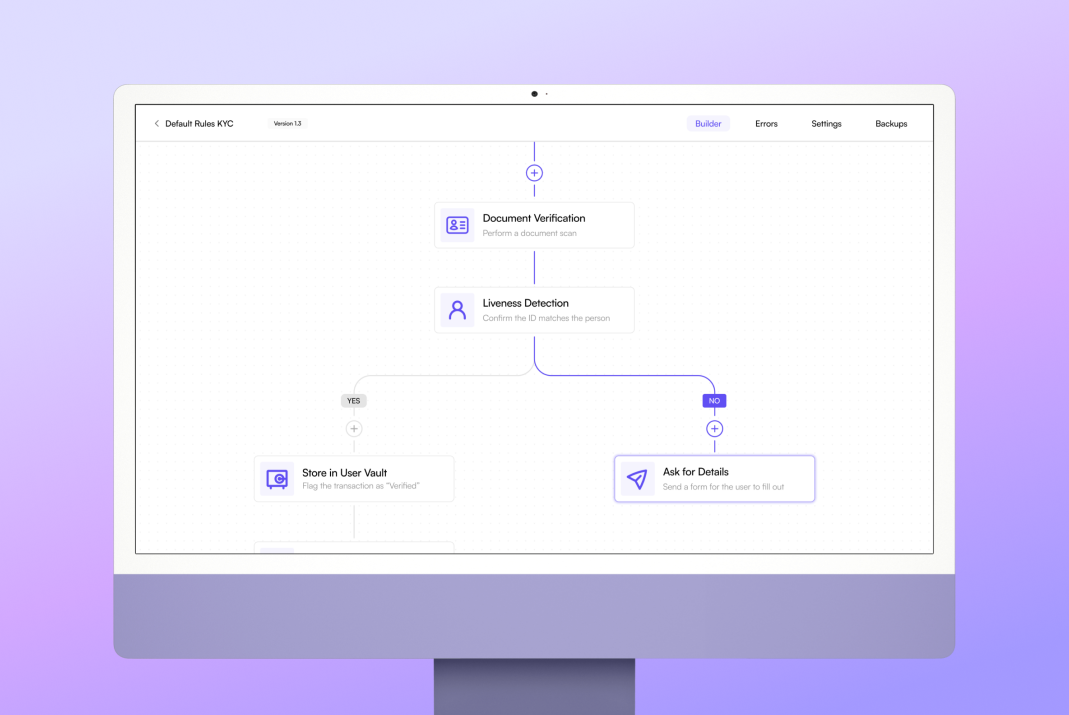
The following table compares key features of these providers to help you evaluate which decentralized KYC vault architecture best fits your operational needs.
| Provider | Data Residency | Integration Speed | Scalability | Primary Focus |
|---|---|---|---|---|
| Zyphe | Off-server, cryptographic | API-first, fast | High, distributed | Privacy-first AI agents |
| Entrust | Centralized ledger, secure | Legacy-friendly, moderate | Enterprise-grade | Banking compliance |
| KYC Chain | On-chain, verifiable | Smart contract-based, slower | DeFi-native, high | DeFi compliance balance |
Technical requirements for vault integration
Building a decentralized KYC vault requires more than just a database; it demands a rigorous cryptographic and API infrastructure that balances user privacy with institutional compliance. The stack must support zero-knowledge proofs (ZKPs) to verify identity attributes without exposing raw personal data, ensuring that the vault acts as a secure, encrypted container rather than a transparent ledger.
1. Cryptographic Standards and ZK-Proofs
The core of the vault relies on advanced cryptographic primitives. You need to implement elliptic-curve cryptography for key management and select a ZK-SNARK or ZK-STARK framework for generating verification proofs. This allows verifiers to confirm that a user meets specific criteria (e.g., age, residency, or sanctions list status) without accessing the underlying identity documents. The protocol must also support selective disclosure, letting users share only the necessary attributes for each transaction.
2. API Integration and Interoperability
A vault is only as useful as its connectivity. The integration layer must support standardized APIs, such as those defined by the FIDO Alliance or W3C Verifiable Credentials, to ensure compatibility with various KYC providers and exchanges. This includes RESTful endpoints for status checks and WebSocket connections for real-time updates. The system should handle data normalization, converting disparate identity formats from different issuers into a unified, machine-readable standard.
3. Crypto Travel Rule Compliance
For virtual asset service providers (VASPs), the vault must facilitate compliance with the Financial Action Task Force (FATF) Travel Rule. This requires secure, encrypted messaging protocols to share originator and beneficiary information between institutions during transfers. The vault should integrate with industry-standard platforms like Notabene or Sygna to automate this data exchange, ensuring that identity verification travels with the asset without creating new data silos.
4. Data Storage and Access Control
Identity data should never reside in a single point of failure. Use decentralized storage solutions like IPFS or Arweave for encrypted document storage, paired with on-chain or off-chain access control lists (ACLs) to manage permissions. Implement multi-party computation (MPC) for key management, ensuring that no single entity holds the full decryption key. This distributed approach mitigates the risk of large-scale data breaches while maintaining auditability for regulatory purposes.
Set up the base cryptographic environment. Install the necessary ZK-proof libraries and configure the key management system using MPC protocols. Define the schema for verifiable credentials that the vault will accept and issue.
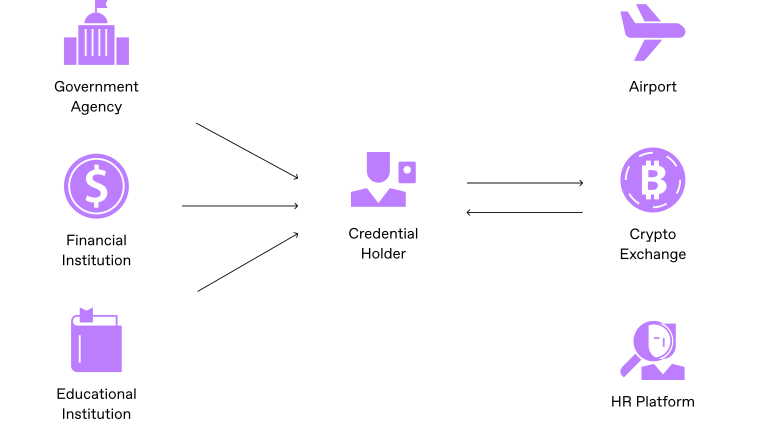
Connect the vault to external KYC providers and VASP networks. Implement the FIDO and W3C standard APIs to ensure seamless data flow. Test the endpoints for latency and security headers to prevent unauthorized access.
Integrate with Travel Rule compliance platforms. Set up encrypted channels for sharing originator and beneficiary data. Ensure that the vault can generate and verify compliance proofs automatically during asset transfers.
Define granular permissions for data access. Use smart contracts or off-chain ACLs to manage who can view or update specific identity attributes. Conduct penetration testing to verify that selective disclosure works as intended.
Implementing decentralized KYC in 2026
Adopting decentralized KYC vaults requires aligning legal frameworks with engineering constraints. The goal is to migrate user identity data into a shared, permissioned network without breaking existing onboarding flows. This process reduces redundancy and ensures a single, golden copy of client data across the institution network.
Begin by identifying which jurisdictions recognize decentralized identity credentials. Legal teams must define the scope of data sharing to ensure compliance with local privacy laws like GDPR or CCPA before any technical integration begins.
Choose a decentralized KYC infrastructure provider that supports your target market. Evaluate their ability to sync data and documents, guaranteeing that updates at one institution reflect across the network without requiring re-verification.
Engineering teams should integrate the provider’s API into your existing user flow. Use a phased rollout to test data synchronization, ensuring that the vault updates in real-time whenever a client’s status changes.
This approach minimizes friction for users while maintaining rigorous compliance standards. By treating identity as a shared asset, institutions can reduce operational costs and improve verification accuracy.
Frequently asked questions about vaults
Decentralized KYC (Know Your Customer) enables institutions to sync data and documents, guaranteeing a single, golden copy of each client and associated natural persons. Whenever a client is onboarded or their data is updated at any institution within the network, this ensures data is kept up-to-date while eradicating duplicates [src-serp-8].
Do decentralized exchanges have KYC? Many decentralized exchanges, like Uniswap and PancakeSwap, do not require ID verification. These are no-KYC platforms that you may not even have to register for, let alone provide ID [src-serp-2]. However, using a Decentralized KYC Vault allows you to maintain compliance without repeatedly submitting documents to every new protocol.
How do vaults handle data synchronization? The vault architecture creates a unified identity layer. Instead of re-verifying with every DEX, you update your status once in the vault. This single source of truth propagates across the network, reducing friction for both users and regulated entities.
No comments yet. Be the first to share your thoughts!