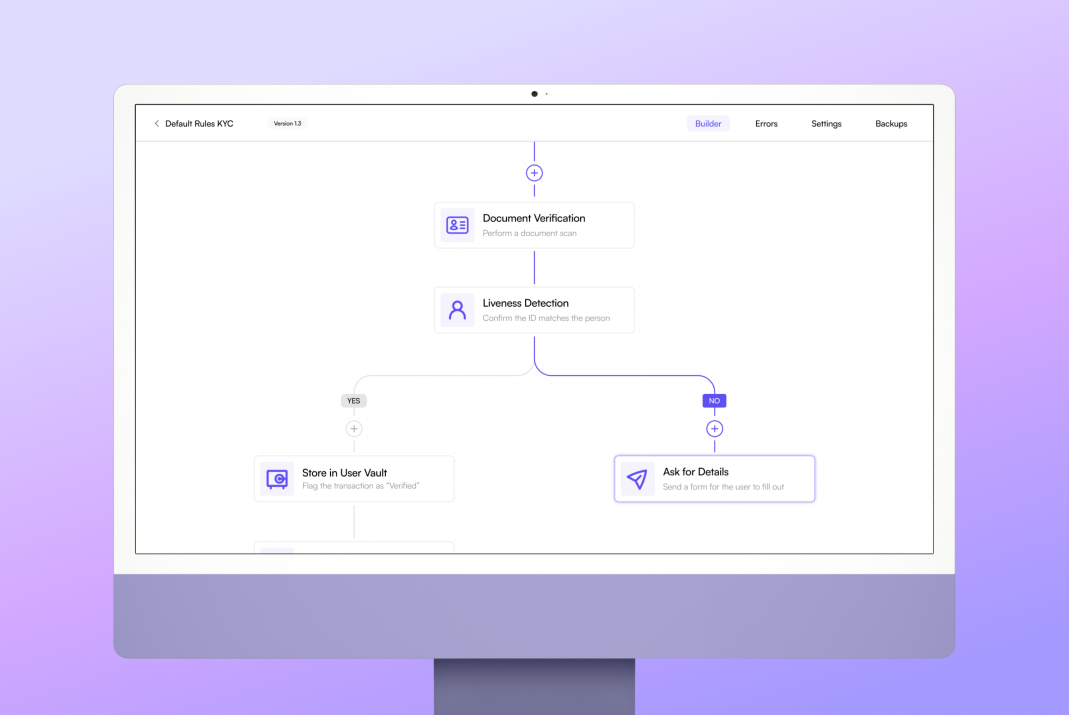
What decentralized KYC vaults actually are
A decentralized KYC vault shifts the burden of identity verification away from centralized corporate databases and places it into user-controlled storage. Instead of handing your passport, selfie, and address to a service provider every time you sign up for a new platform, you store these documents in a secure, personal vault. You then generate cryptographic proofs that verify your identity without revealing the underlying data.
This architecture addresses the primary weakness of legacy systems: the single point of failure. When a centralized database is breached, millions of users lose their identity data simultaneously. With a vault, your documents remain encrypted and offline until you explicitly choose to share a specific claim, such as "I am over 18" or "I am not on a sanctions list."
The infrastructure relies on decentralized identifiers (DIDs) and verifiable credentials. These standards allow you to hold a digital wallet that contains your identity attributes. When a regulated entity needs to onboard you, they request a proof. Your vault signs this proof using your private key, and the verifier checks it against the issuer's public key. This process eliminates the need for redundant data collection and reduces the risk of identity theft across the ecosystem.
How the infrastructure works under the hood
A decentralized KYC vault doesn't store your passport image in a central database. Instead, it acts as a secure digital wallet for your credentials, using a stack of three core technologies: Decentralized Identifiers (DIDs), Verifiable Credentials (VCs), and Zero-Knowledge Proofs (ZKPs). This architecture shifts control from institutions back to you, allowing you to prove you are over 18 or a resident of a specific jurisdiction without revealing your actual birthdate or address.
Decentralized Identifiers (DIDs)
Think of a DID as your unique digital fingerprint on a blockchain. Unlike a traditional username or email, a DID is not controlled by a central authority like Google or a government agency. Instead, it is a globally unique string of characters that you control via cryptographic keys. When you create a DID, you register a lightweight reference on a public ledger, which serves as a public directory to verify that the identifier exists and hasn't been revoked. This reference points to a "DID Document" containing your public keys, allowing anyone to verify your identity without needing to ask a central server for permission.
Verifiable Credentials (VCs)
If a DID is your identity, a Verifiable Credential is the proof. VCs are digital versions of physical credentials like a driver's license or university degree, issued by trusted entities (the "issuers"). These credentials are cryptographically signed, making them tamper-proof. When you receive a VC, it is stored in your decentralized KYC vault. The key difference here is portability: you can move your credentials between different wallets and present them to any "verifier" (such as a bank or exchange) without the issuer needing to be involved in the transaction. This creates a trustless environment where verification relies on cryptographic signatures rather than institutional intermediaries.
Zero-Knowledge Proofs (ZKPs)
The final piece of the puzzle is privacy. Zero-Knowledge Proofs allow you to prove a statement is true without revealing the underlying data. In the context of KYC, this means you can prove you meet a specific requirement—such as being over 18 or holding a license from a regulated jurisdiction—without disclosing your exact date of birth, full name, or license number. The verifier receives a mathematical proof that confirms the data matches their criteria, ensuring compliance while minimizing data exposure. This is critical for regulatory adherence, as it aligns with privacy-by-design principles required by frameworks like GDPR.
This stack ensures that your sensitive personal information remains encrypted and under your sole control. The vault only releases the minimum necessary data to satisfy regulatory checks, reducing the attack surface for data breaches. By combining DIDs for identity, VCs for trust, and ZKPs for privacy, decentralized KYC solutions offer a more secure and user-centric alternative to traditional centralized databases.
Market landscape and key players
The market for decentralized identity infrastructure in 2026 is defined by a shift from static identity databases to dynamic, user-owned verification layers. Infrastructure providers are no longer just storing data; they are orchestrating how that data is verified, shared, and revoked. This transition is driven by regulatory pressure for compliance and user demand for privacy, creating a niche where technology must satisfy both legal frameworks and individual rights.
Leading providers are integrating AI-augmented verification to handle the complexity of cross-border identity checks. These systems use AI agents to validate documents and biometric data against global watchlists before committing any proof to the blockchain. This approach reduces the latency of verification while ensuring that the underlying infrastructure remains compliant with evolving standards like the EU’s MiCA and various AML directives.
Infrastructure provider comparison
The following table compares the core attributes of major decentralized KYC infrastructure providers. These metrics reflect current capabilities in privacy preservation, verification speed, and regulatory alignment.
| Provider | Privacy Model | Verification Speed | Compliance Focus |
|---|---|---|---|
| Zyphe | User-owned vaults with AI agents | Near real-time | Global AML/KYC standards |
| Spruce ID | Verifiable Credentials (VCs) | Fast (pre-built protocols) | W3C standards & enterprise |
| Polygon ID | Zero-Knowledge Proofs (ZKPs) | Moderate (ZK circuit generation) | Selective disclosure & privacy |
| Civic | Decentralized identity network | Real-time | Consumer-focused KYC/AML |
Regulatory alignment and future outlook
Compliance remains the primary hurdle for adoption. Providers that can demonstrate how their vaults meet regulatory requirements without exposing sensitive personal identifiable information (PII) are gaining traction. The focus is on "privacy-by-design," where the system proves a user is eligible to transact without revealing who they are or where they live, unless explicitly required by law.
As the market matures, we expect to see more interoperability between different vault providers. This will allow a user to verify their identity once and use that credential across multiple platforms, reducing friction for both consumers and institutions. The decentralized identity ecosystem is moving toward a unified standard where identity is portable, secure, and compliant.
Compliance strategy for high-stakes environments
Building a robust decentralized identity solution requires more than just technical architecture; it demands a rigorous legal framework. In high-stakes environments, the goal is to maintain GDPR and CCPA compliance while leveraging decentralized identity. The core mechanism for this is data minimization. By storing only the necessary proofs on-chain and keeping personal data off-chain, you reduce liability and align with privacy-by-design principles.
1. Define Data Boundaries and Storage
The first step is determining what data stays off-chain. Personal Identifiable Information (PII) should never be stored on a public blockchain. Instead, use decentralized storage solutions like IPFS or Arweave for encrypted documents, with only the cryptographic hash stored on-chain. This ensures that the integrity of the KYC process is verifiable without exposing sensitive user data. Entrust notes that this model helps organizations share KYC information securely and cost-effectively while maintaining control over sensitive records [src-serp-5].
2. Implement Zero-Knowledge Proofs
Zero-knowledge proofs are essential for verifying compliance without revealing underlying data. For example, a user can prove they are over 18 or reside in a specific jurisdiction without disclosing their exact birthdate or address. This approach minimizes data exposure and reduces the attack surface for potential breaches. It allows institutions to satisfy regulatory requirements for identity verification while preserving user privacy, a critical balance in decentralized finance (DeFi) and other regulated sectors [src-serp-4].
3. Establish Clear Consent and Revocation Mechanisms
Users must have explicit control over their identity data. Implement smart contracts that allow users to grant and revoke access to their KYC credentials. This aligns with GDPR’s right to erasure and CCPA’s right to delete. Ensure that revocation triggers the invalidation of associated on-chain proofs or updates the status in the decentralized identity registry. Lithic emphasizes that clear operational guidelines for consent and revocation are vital for building trust and maintaining regulatory compliance [src-serp-7].
4. Conduct Regular Compliance Audits
Regular audits ensure that your implementation remains compliant with evolving regulations. Engage third-party auditors to review your smart contracts, data storage practices, and consent mechanisms. Document all audit findings and remediation steps. This proactive approach demonstrates due diligence and helps identify potential vulnerabilities before they become legal issues.
5. Maintain Regulatory Documentation
Keep detailed records of your compliance strategy, including data flow diagrams, privacy impact assessments, and legal opinions. These documents are crucial for demonstrating compliance to regulators and partners. Ensure that all documentation is up-to-date and easily accessible for review. This transparency builds trust with users and regulators alike, reinforcing the legitimacy of your decentralized identity solution.
Common pitfalls in decentralized identity adoption
Building a decentralized KYC vault introduces friction that traditional systems hide behind centralized gatekeepers. The most immediate barrier is user experience. Asking users to manage cryptographic keys and private wallets before they can access basic services creates a steep learning curve. This complexity often leads to abandonment, especially when the value proposition isn't immediately clear to non-technical users.
Key management remains a persistent burden. Unlike centralized accounts where password recovery is standard, decentralized identity requires users to safeguard their own credentials. Loss of a private key means permanent loss of access to identity proofs and associated assets. This responsibility shifts significant risk onto the user, demanding robust education and intuitive recovery mechanisms that many current solutions still lack.
Interoperability gaps further complicate adoption. Different Decentralized Identifier (DID) standards and verifiable credential formats rarely align seamlessly across platforms. A KYC proof issued by one protocol may not be recognized by another, forcing users to repeat verification processes. This fragmentation undermines the core promise of portable, reusable identity, creating silos that hinder widespread enterprise and DeFi integration.
No comments yet. Be the first to share your thoughts!