What decentralized KYC vaults actually do
A decentralized KYC vault is a user-controlled container that separates identity verification from data storage. In traditional compliance workflows, you submit your passport or driver’s license to a centralized server, creating a single point of failure for data breaches. The vault flips this model: you hold the raw Personally Identifiable Information (PII) in your own secure environment, sharing only cryptographic proofs that you meet specific criteria.
Think of the vault as a digital safe deposit box. When a business needs to verify your age or residency, you don’t hand over your ID card. Instead, you use a zero-knowledge proof to demonstrate that the ID inside your vault meets their requirements without revealing the document itself. This architecture ensures that sensitive data never leaves your control, significantly reducing liability for both the user and the verifier.
This approach relies on decentralized identity standards, such as those promoted by Dock Labs, to ensure that credentials are verifiable across different platforms without a central authority. By keeping the "key" to your identity in your hands, you can grant or revoke access to businesses on demand, rather than relying on a permanent record held by a third party. This shift transforms KYC from a static data dump into a dynamic, privacy-preserving interaction.
Market leaders and infrastructure models
The decentralized KYC vaults guide reveals a fragmented but maturing landscape. Rather than a single dominant standard, the market is defined by competing architectural philosophies. Each major player prioritizes a different balance between regulatory compliance, user privacy, and developer integration. Understanding these technical differences is essential for selecting the right infrastructure for your specific use case.
Dock: The DID Foundation
Dock positions itself as the foundational layer for decentralized identity. Its approach relies heavily on W3C-compliant Decentralized Identifiers (DIDs) and Verifiable Credentials. This model allows issuers to sign credentials that users store in their own wallets, creating a portable identity graph. Dock’s infrastructure is designed to be interoperable, meaning a credential issued on Dock can theoretically be verified by any system that supports the standard. This makes it a strong candidate for broad, cross-platform KYC requirements where data portability is key.
Zyphe: Privacy-First PII Storage
Zyphe takes a different route by focusing on the secure storage of Personally Identifiable Information (PII). Instead of just managing credentials, Zyphe uses cryptographic vaults to keep sensitive data off central servers. This architecture reduces liability for businesses by ensuring that raw PII is never stored in their own databases. Verification happens through zero-knowledge proofs or selective disclosure, allowing users to prove they meet KYC criteria without revealing the underlying data. This model is particularly attractive for high-stakes financial institutions concerned with data breach risks.
KYC Chain: Oracle-Based Verification
KYC Chain operates as an oracle network that bridges traditional identity data with blockchain-based systems. It acts as a middleware layer, aggregating verification results from various providers and making them available on-chain. This approach is ideal for DeFi protocols that need to check user status without handling sensitive data directly. By abstracting the verification process, KYC Chain allows developers to integrate compliance checks via simple API calls or smart contract interactions, significantly lowering the barrier to entry for decentralized applications.
| Provider | Core Model | Privacy Guarantee | Primary Use Case |
|---|---|---|---|
| Dock | DID & Verifiable Credentials | User-held credentials | Cross-platform interoperability |
| Zyphe | Cryptographic PII Vaults | Zero-knowledge storage | High-security TradFi |
| KYC Chain | Oracle Aggregation | Selective disclosure | DeFi protocol integration |
The choice between these models depends on your risk profile and technical stack. Dock offers the most flexibility for standard-compliant systems. Zyphe provides the strongest data protection for sensitive PII. KYC Chain delivers the easiest integration for blockchain-native applications. As the decentralized KYC vaults guide suggests, there is no one-size-fits-all solution; the right architecture aligns with your specific compliance and privacy requirements.
Regulatory alignment and compliance risks
Decentralized KYC vaults sit at the center of a high-stakes tension between user privacy and regulatory mandates. While these vaults use zero-knowledge proofs to verify identity without exposing raw data, regulators like the EU, US FinCEN, and global FATF bodies are focused on the end result: preventing money laundering and terrorist financing. The core challenge for any Decentralized KYC Vaults guide participant is navigating how on-chain anonymity interacts with off-chain legal requirements.
MiCA and the Travel Rule
The EU’s Markets in Crypto-Assets (MiCA) regulation sets a strict baseline for asset service providers. It requires robust AML/CFT compliance, which often conflicts with the pseudonymous nature of public blockchains. The FATF’s "Travel Rule" further complicates matters by demanding that virtual asset service providers (VASPs) share originator and beneficiary information during transfers.
Decentralized vaults must bridge this gap. They need to prove compliance to regulators without handing over the entire user database. This means the vault architecture must support selective disclosure—proving a user is not on a sanctions list without revealing their name or address to every node in the network.
FinCEN and US Oversight
In the United States, FinCEN guidelines apply the Bank Secrecy Act to digital assets. The key question is whether the entity operating the vault is considered a Money Services Business (MSB). If the vault facilitates transactions or exchanges, it likely falls under FinCEN’s purview. This creates a compliance risk: if the vault’s smart contracts are immutable and cannot freeze assets or blacklist addresses, it may struggle to meet regulatory demands for asset seizure or account restriction.
Regulatory Note: While vaults protect user privacy, regulators often require identifiable data for AML/CFT. Solutions must balance zero-knowledge proofs with legal reporting obligations.
The Compliance Paradox
The tension is structural. Decentralization aims to remove intermediaries, but compliance requires identifiable intermediaries. If a vault is truly decentralized, who is liable for a compliance breach? This legal ambiguity is the primary risk for projects building Decentralized KYC Vaults guide infrastructure. They must design systems that are technically decentralized but legally accountable, often requiring a hybrid model where a trusted entity holds the keys to compliance data while users retain control over their private keys.
Key Takeaways
- Privacy vs. Reporting: Zero-knowledge proofs allow identity verification without data exposure, but regulators may still demand identifiable data for audits.
- MiCA/Travel Rule: These frameworks require VASPs to share transfer data, challenging the pseudonymous nature of DeFi.
- Liability: True decentralization complicates legal accountability, creating a paradox for vault operators who must be both anonymous and compliant.
How Decentralized KYC Vaults Verify Identity
A Decentralized KYC Vault works like a digital safe deposit box for your personal data. Instead of uploading raw documents—like a passport scan or selfie—to every service you use, you store them in a secure, encrypted vault on a blockchain network. The system relies on three core components: Decentralized Identifiers (DIDs) to establish who you are, Verifiable Credentials (VCs) to prove specific facts about you, and smart contracts to enforce the rules of verification.
When you need to prove your identity to a verifier (such as a bank or exchange), you don't send them your actual documents. Instead, you present a Verifiable Credential issued by a trusted authority, like a government agency or a certified KYC provider. This credential is a cryptographically signed statement that confirms you meet certain criteria, such as being over 18 or passing an AML check, without revealing your underlying personal details. This process is known as zero-knowledge proof or selective disclosure, allowing you to share only what is necessary.
The interaction between the user, the vault, and the verifier is governed by smart contracts. These self-executing contracts on the blockchain validate the cryptographic signatures of the credentials. They ensure that the VC is authentic, has not been revoked, and was issued by a recognized entity. If the data matches the required criteria, the smart contract generates a verification token that the verifier can accept. This architecture ensures that your raw data remains private in your vault, while the verifier receives a trustworthy, tamper-proof confirmation of your eligibility.

This flow shifts control back to the user. You decide which credentials to share and with whom. If a credential expires or is revoked by the issuer, the smart contract reflects this change immediately, ensuring that verifiers always have up-to-date information without needing to re-collect data from you. This reduces friction for users and lowers compliance costs for businesses, as they no longer need to store and secure sensitive personal data themselves.
Choosing a vault solution for your protocol
Selecting the right decentralized KYC vault requires balancing regulatory obligations with technical constraints. Your choice should align with your jurisdiction's data residency laws and your protocol's existing identity infrastructure. This decision framework helps you evaluate providers against four critical dimensions: compliance, interoperability, data privacy, and audit readiness.
Not all vaults support every regulatory framework. Ensure the provider explicitly supports the jurisdictions where your users reside. Check if they handle specific requirements like GDPR's right to erasure or CCPA data access requests. Providers like Regula Forensics offer specialized compliance modules for different regions.
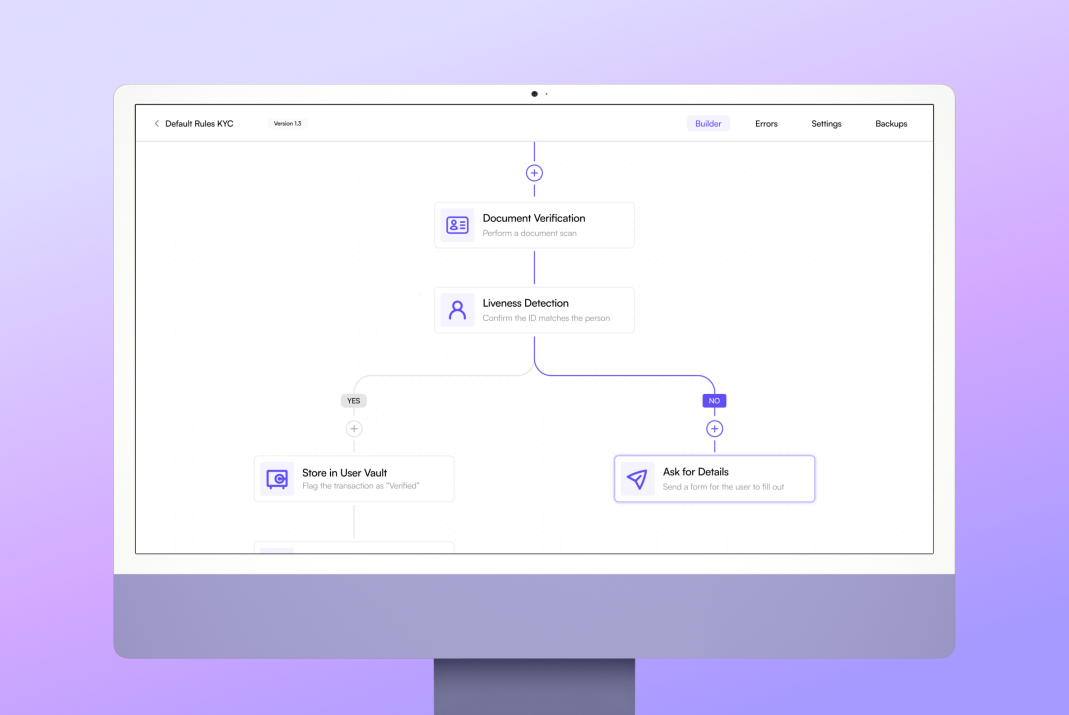
Your vault must issue Verifiable Credentials that work across your ecosystem. Look for native support for W3C VC and DIDs. This ensures that identity proofs issued by the vault can be verified by other protocols without custom integrations. Interoperability reduces friction for users moving between different DeFi applications.
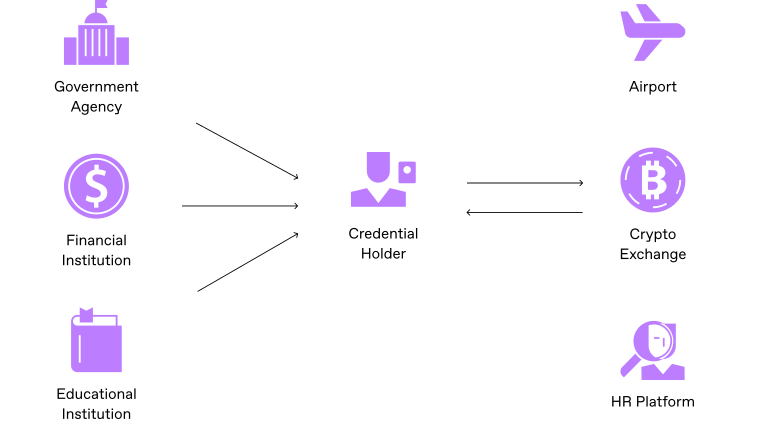
Decentralized KYC should minimize data exposure. Prioritize vaults that use zero-knowledge proofs (ZKPs) to verify attributes without revealing underlying personal data. This approach limits the attack surface and aligns with privacy-first design principles. Avoid solutions that store raw PII on-chain or in accessible off-chain databases.
Security is non-negotiable. Review the provider's past security audits and incident response history. Look for third-party audits from reputable firms. A clean audit history indicates robust code practices and transparency. Avoid providers with unresolved security vulnerabilities or opaque security policies.
Use this checklist to compare potential vault providers systematically.
By following these steps, you can select a decentralized KYC vault that meets both legal requirements and technical needs. This structured approach minimizes risk and ensures a smoother integration process for your protocol.
No comments yet. Be the first to share your thoughts!