Defining decentralized KYC infrastructure
Decentralized KYC vaults represent a fundamental shift in how financial institutions manage identity verification. Instead of relying on a central authority to store and verify client data, these systems use distributed ledgers and cryptographic protocols to create a user-controlled identity layer. This infrastructure allows institutions to verify credentials without holding the underlying sensitive data, significantly reducing liability and regulatory exposure.
At the core of this architecture are Decentralized Identifiers (DIDs) and Verifiable Credentials (VCs). A DID is a unique identifier that the user controls, while a VC is a tamper-proof digital record issued by a trusted entity, such as a bank or government agency. Together, they form the basis of a decentralized identity system where the user grants permission for specific data points to be shared, rather than handing over entire files.
Note: It is common to confuse DIDs with VCs. Think of a DID as your unique ID number and a VC as your diploma. The DID proves who you are on the network; the VC proves a specific attribute (like age or employment) without revealing your entire history.
Traditional centralized KYC databases create "silos" of data. Each institution maintains its own copy of customer information, leading to redundant verification processes and increased costs. Decentralized KYC vaults solve this by enabling a "golden copy" of client data that can be securely synced across institutions. When a client updates their information at one institution, that update can be propagated to others, ensuring data consistency and reducing the risk of outdated or duplicate records.
This model prioritizes data sovereignty. Users retain ownership of their identity data and can revoke access at any time. For institutions, this means compliance with regulations like GDPR and emerging decentralized identity standards becomes more manageable, as they no longer bear the full burden of data storage and security. The result is a more efficient, secure, and user-centric approach to Know Your Customer compliance.
Market landscape and key infrastructure providers
The decentralized KYC market is shifting from experimental prototypes to institutional-grade infrastructure. Providers are no longer just building wallets; they are constructing the cryptographic vaults and verification networks that allow financial institutions to share identity data without centralizing liability. This transition addresses the primary bottleneck of traditional KYC: the repeated, costly, and insecure storage of Personally Identifiable Information (PII) across siloed databases.
Current infrastructure layers generally fall into three categories: decentralized identity (DID) issuers, zero-knowledge proof (ZKP) verifiers, and secure PII storage networks. Each layer solves a specific part of the compliance puzzle. Issuers create the digital credential, verifiers confirm its validity without revealing the underlying data, and storage networks ensure that any sensitive details remain encrypted and off-chain. The most robust solutions integrate all three, allowing a bank to verify a customer’s identity once and reuse that proof across the network.
To understand how these providers differ in technical approach and compliance readiness, the table below compares four leading infrastructure platforms. These selections reflect current market leaders in cryptographic standards, data residency options, and integration complexity for enterprise adoption.
| Provider | Core Technology | Data Residency | Integration Complexity |
|---|---|---|---|
| Zyphe | Cryptographic Vaults | User-Controlled | API-First |
| Polygon ID | Zero-Knowledge Proofs | On-Chain (Minimal) | SDK-Heavy |
| Sovrin Network | DID/VC Ledger | Governed Nodes | Middleware |
| Blockstack | Gaia Storage | User-Sovereign | Developer SDK |
The choice of infrastructure often hinges on the balance between privacy and regulatory auditability. Solutions like Zyphe focus on keeping PII entirely off-chain and encrypted, which simplifies GDPR compliance but requires robust key management. In contrast, platforms like Polygon ID leverage zero-knowledge proofs to verify attributes (e.g., "over 18") without exposing the birth date at all, offering stronger privacy but higher computational overhead. For institutions, the decision is rarely about picking a single technology but selecting a provider whose cryptographic model aligns with their specific risk appetite and existing tech stack.
Compliance strategies for regulated markets
Decentralized KYC vaults operate at the intersection of Web3 privacy and traditional financial oversight. For institutions navigating GDPR, MiCA, and AML regulations, the primary challenge is verifying identity without storing sensitive personal data on immutable ledgers. The solution lies in shifting from data storage to data verification.
Instead of keeping passports or biometric scans on-chain, vaults store cryptographic proofs of identity. This approach allows regulators to confirm that a user has passed strict checks without accessing the underlying documents. It satisfies the "data minimization" principle required by GDPR, where personal information is kept to the absolute minimum necessary for the transaction.
Under MiCA, stablecoin issuers and service providers must implement robust AML frameworks. Decentralized vaults facilitate this by creating a "golden copy" of verified identity data. When a user updates their status, the change syncs across the network, ensuring all participating institutions have the most current information without redundant uploads. This reduces operational friction while maintaining a clear audit trail for compliance officers.
The architecture ensures that identity verification is a one-time event. Once a user’s credentials are validated by a trusted provider, the resulting proof can be reused across different DeFi protocols. This eliminates the repetitive burden of constant re-verification, streamlining onboarding while keeping the user’s private keys and personal data secure off-chain.
How the Vault Stores and Verifies Data
Decentralized KYC vaults function as privacy-preserving storage layers that sit between the user and the verifier. Instead of sending raw identity documents to every institution, the vault holds the encrypted data off-chain. The blockchain is used only to manage access permissions and record verification proofs, not to store personal information. This separation ensures that sensitive identity data remains under the user’s control while still allowing institutions to trust the verification outcome.
The process begins when a user uploads their identity documents to the vault. The data is encrypted using the user’s private key, meaning the vault provider cannot read the contents. When an institution needs to verify a client, the user grants temporary access. The vault then generates a cryptographic proof that the data is valid and unchanged. This proof is signed and recorded on the blockchain, allowing the verifier to confirm the identity without seeing the underlying documents.
This architecture relies on zero-knowledge proofs or similar cryptographic techniques to maintain privacy. The verifier can check the validity of the proof without accessing the raw data. This approach reduces the risk of data breaches and ensures compliance with regulations like GDPR. By keeping the identity data off-chain and using the blockchain for trust and access control, decentralized KYC vaults provide a secure and efficient way to manage identity verification.
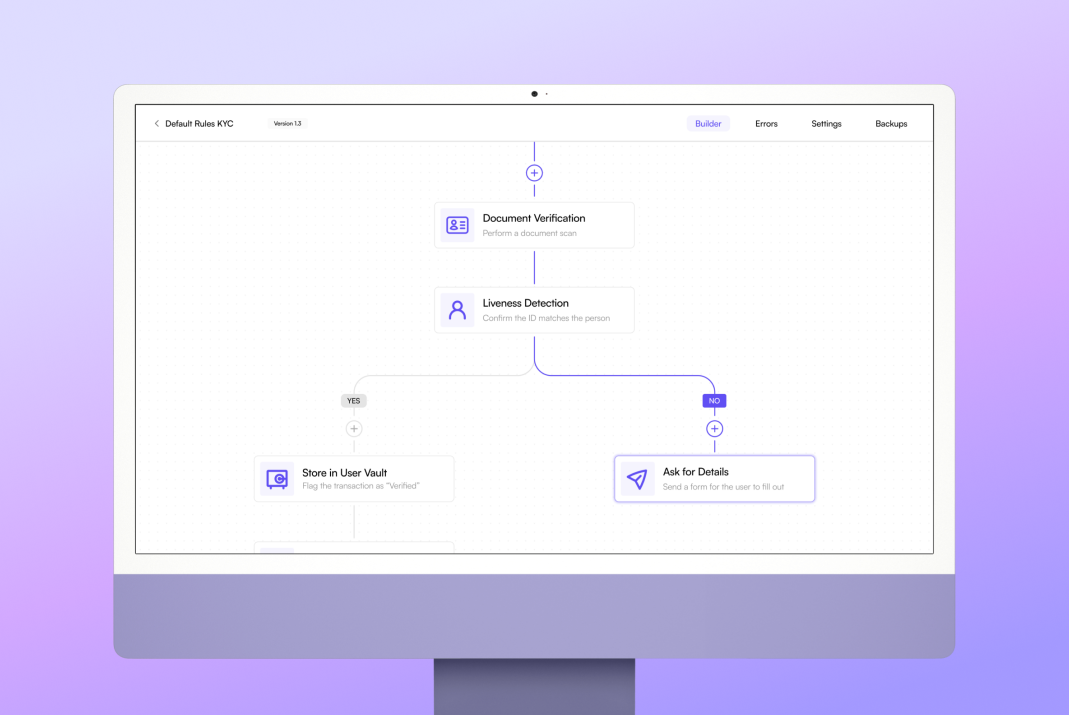
The technical flow involves three main components: the user wallet, the off-chain vault, and the verifier smart contract. The user wallet holds the private keys and manages access permissions. The off-chain vault stores the encrypted identity data. The verifier smart contract on the blockchain records the verification proofs and manages the access control logic. This separation of concerns ensures that the system is scalable, secure, and compliant with regulatory requirements.
How to integrate decentralized KYC
Adopting decentralized identity (DID) requires shifting from a centralized data hoard to a user-centric verification model. For Web3 projects, this means building infrastructure that respects data minimization while satisfying regulatory obligations. The goal is to create a "golden copy" of client data that updates across the network, eliminating duplicates and ensuring accuracy [1].
1. Select a compliant DID framework
Start by choosing a decentralized identity standard that aligns with your target jurisdiction. Frameworks like W3C DID and Verifiable Credentials (VC) provide the technical backbone for issuing and verifying identity proofs. Ensure the provider supports the specific credential types required by your local regulations, such as AML or CDD mandates.
2. Define data minimization policies
Decentralized KYC allows you to verify attributes without storing raw documents. Implement zero-knowledge proof (ZKP) mechanisms where possible. This lets users prove they are over 18 or reside in a specific country without revealing their exact birthdate or address. This approach reduces your liability surface and aligns with privacy-first design principles.
3. Integrate with existing onboarding flows
Embed the verification step into your user journey using SDKs from established providers. The integration should be seamless, allowing users to present their DID wallet credentials directly. Avoid forcing users to upload new documents if they have already been verified by a trusted issuer in the network.
4. Establish continuous monitoring
KYC is not a one-time event. Set up automated triggers to re-verify users when their credentials expire or when risk signals change. Use decentralized oracles to pull real-time sanctions list updates. This ensures your "golden copy" of the client remains current without manual intervention.
Map where PII currently lives. Identify bottlenecks where centralized storage creates single points of failure or compliance risks. This audit informs which data points can be offloaded to user-controlled wallets.
Partner with a reputable identity issuer or build your own using open standards. The issuer must be trusted by your compliance team and capable of signing credentials that your system can independently verify.
Deploy a smart contract or off-chain verifier that checks the cryptographic signature of the presented credential. Ensure the contract rejects expired or revoked credentials and logs the verification event for audit trails.
5. Test with a pilot group
Launch a closed beta with a small cohort of users. Monitor drop-off rates during the verification step. If users struggle to present their credentials, simplify the UI. Gather feedback on the friction points between traditional KYC and decentralized alternatives.
6. Scale and monitor compliance
Once the pilot is stable, roll out the solution to all new users. Continuously monitor the verification success rates and any false positives. Adjust your risk thresholds based on real-world data. Regularly update your smart contracts to address any emerging vulnerabilities or regulatory changes.
No comments yet. Be the first to share your thoughts!