The shift from centralized to vault-based identity
Traditional centralized KYC databases are increasingly viewed as liability risks rather than compliance assets. For financial institutions and regulated entities, maintaining a single, massive repository of sensitive personal data creates a high-value target for cybercriminals. When a centralized server is breached, the fallout is catastrophic, affecting millions of users and exposing the institution to severe regulatory penalties and reputational damage.
Decentralized KYC vaults offer a structural alternative by shifting the locus of control. Instead of storing raw personal data on a central server, these vaults store verifiable credentials on a distributed ledger or encrypted off-chain storage. The user retains ownership of their identity data, granting permissioned access to institutions only when necessary. This approach aligns with the principles of decentralized identity, where the individual, not the institution, controls their digital self [[src-serp-1]].
This model addresses the core tension in modern compliance: the need to verify identity without hoarding it. By using cryptographic proofs rather than raw data transfers, institutions can confirm that a user meets regulatory requirements—such as age verification or anti-money laundering checks—without ever seeing their underlying personal information. This reduces the attack surface for data breaches and lowers the cost of compliance operations.
The transition is not merely technological but strategic. As regulatory frameworks evolve to emphasize data minimization and user consent, the centralized database model becomes unsustainable. Decentralized vaults provide a path forward that satisfies both legal obligations and privacy expectations, transforming identity verification from a static record-keeping exercise into a dynamic, user-centric process [[src-serp-4]].
Core architecture of decentralized identity vaults
A decentralized KYC vault functions as a cryptographic container for personal identity data. Instead of storing raw PII—such as passport scans or utility bills—on a central server vulnerable to breaches, the vault holds the encrypted documents locally or in secure, distributed storage. The system relies on three technical pillars to verify identity without exposing sensitive information: Decentralized Identifiers (DIDs), Verifiable Credentials (VCs), and Zero-Knowledge Proofs (ZKPs).
Decentralized Identifiers (DIDs)
DIDs provide a unique, persistent identifier that is not controlled by any single authority, such as a government or corporation. Unlike traditional usernames or email addresses, DIDs are self-sovereign, meaning the user owns and controls the key pair associated with the identifier. This allows individuals to maintain a consistent digital identity across different platforms and services without relying on centralized registries. The W3C defines DIDs as a method to ensure that the identity is cryptographically verifiable and portable.
Verifiable Credentials (VCs)
Verifiable Credentials are digital versions of physical credentials, like a driver’s license or university degree, but with enhanced security. They are issued by trusted entities (issuers) and held by the user in their vault. Each VC contains claims about the user, signed by the issuer, which can be cryptographically verified by anyone without needing to contact the issuer. This eliminates the need for manual document verification and reduces the risk of forgery. The W3C Verifiable Credentials Data Model provides the standard for these digital credentials.
Zero-Knowledge Proofs (ZKPs)
Zero-Knowledge Proofs allow a user to prove a statement is true without revealing the underlying data. In the context of KYC, this means a user can prove they are over 18, reside in a specific country, or are not on a sanctions list, without disclosing their exact birthdate, address, or name. This is the core privacy feature of decentralized KYC vaults. By using ZKPs, compliance checks can be performed on encrypted data, ensuring that only the necessary information is shared with the verifier. This approach minimizes data exposure and aligns with privacy-by-design principles.
How it works in practice
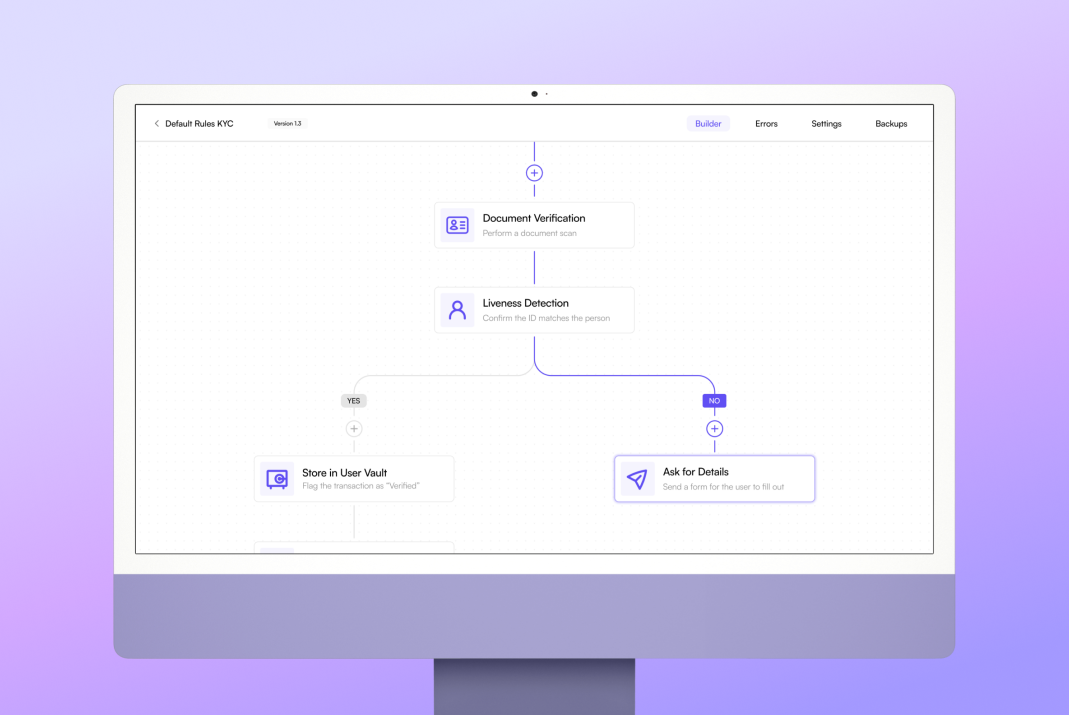
The process begins when a user requests a service that requires KYC. The verifier sends a request specifying the required claims (e.g., age, residency). The user’s vault generates a zero-knowledge proof based on the stored Verifiable Credentials. This proof is sent to the verifier, who checks its validity against the issuer’s public key. If the proof is valid, the service is granted access. The user’s raw PII never leaves the vault, and the verifier never sees the underlying data. This flow ensures compliance while preserving user privacy.
The decentralized kyc vaults landscape
The infrastructure supporting decentralized identity is no longer theoretical. A distinct set of providers has emerged to bridge the gap between traditional regulatory requirements and the privacy-first ethos of blockchain networks. These players generally fall into two camps: those building specialized identity layers for DeFi protocols and those adapting legacy banking infrastructure for on-chain use.
For DeFi-native applications, the priority is seamless integration with smart contracts. Solutions like Zyphe focus on cryptographic identity vaults that keep personal data off central servers. This approach minimizes liability for protocol operators, ensuring that sensitive PII (Personally Identifiable Information) does not become a honeypot for attackers. The goal is to allow users to prove compliance without exposing their raw data to the protocol itself.
In the TradFi space, the challenge is different. Banks need to share KYC information securely and cost-effectively across existing silos. Providers like Entrust are adapting decentralized identity models to help institutions solve these sharing challenges. Here, the focus is less on novel cryptography and more on interoperability with existing AML (Anti-Money Laundering) frameworks and legal standards. The infrastructure must be robust enough to satisfy regulators while reducing the redundant cost of re-verifying customers across different financial institutions.
| Provider / Platform | Primary Target Market | Data Storage Model | Regulatory Alignment Focus |
|---|---|---|---|
| Zyphe | DeFi Protocols | Cryptographic Vaults (Off-chain) | GDPR, Data Minimization |
| Entrust | Traditional Finance | Hybrid Distributed Ledger | KYC/AML, Banking Compliance |
| KYC-Chain | DeFi & Web3 | Decentralized Identity Layer | Balance of Privacy & Compliance |
This divergence creates a fragmented but growing market. As the decentralized kyc vaults guide suggests, choosing the right infrastructure depends on whether the primary goal is user privacy in a permissionless environment or regulatory interoperability in a permissioned one. The infrastructure providers listed above represent the current standard-bearers in these distinct lanes.
Compliance challenges and regulatory alignment
Decentralized KYC vaults operate in a high-stakes environment where regulatory mandates collide with the core ethos of self-custody. Navigating this tension is the primary hurdle for any implementation. The infrastructure must satisfy stringent requirements from frameworks like the EU’s GDPR and MiCA, as well as global Anti-Money Laundering (AML) standards, without creating a central point of failure that regulators could easily target or exploit.
The GDPR presents a specific paradox: the "right to be forgotten" clashes with the immutable nature of blockchain ledgers. Vault architectures address this by storing only cryptographic proofs or zero-knowledge attestations on-chain, while keeping the underlying personally identifiable information (PII) in off-chain, encrypted storage. This separation ensures that user data can be deleted or updated in compliance with privacy laws, while the blockchain retains only the verifiable status of the vault. This approach aligns with the principles outlined in recent analyses of striking a balance between compliance and decentralization [src-serp-3].
Similarly, MiCA introduces clarity for asset issuers and service providers, requiring robust identity verification for access to crypto-asset services. Vaults must integrate these verification steps seamlessly into the user journey. Rather than forcing users to submit documents to a central authority, decentralized models allow users to present credentials issued by trusted, regulated entities. This method supports AML goals by ensuring that only verified participants can interact with the vault, while maintaining the user’s control over their data. As noted in industry guides on KYC operations, building these operations requires careful consideration of where verification data is held and how it is accessed [src-serp-6].
Ultimately, the goal is regulatory alignment without sacrificing sovereignty. By treating compliance as a modular layer rather than a monolithic gate, decentralized vaults can adapt to evolving legal landscapes. This flexibility is essential for long-term viability, allowing the infrastructure to remain compliant with local laws while preserving the open, permissionless nature of the broader ecosystem.
Strategic implementation for Web3 firms
Building a decentralized KYC vault requires aligning technical architecture with rigid regulatory expectations. You are not just storing data; you are managing liability. The goal is to verify identity without centralizing sensitive Personally Identifiable Information (PII) in a way that invites breaches or regulatory scrutiny.
Start by mapping your data flow. Identify exactly which attributes need to be on-chain (e.g., attestation hashes) versus off-chain (e.g., biometric templates). This distinction dictates your storage strategy and legal exposure.
1. Select a Compliant Identity Provider
Not all KYC vendors support decentralized vaults. Look for providers that offer zero-knowledge proof (ZKP) generation or secure enclave integration. Ensure they comply with GDPR, CCPA, and relevant FinCEN guidance. Regula Forensics notes that crypto startups must prioritize vendors who understand the unique compliance landscape of digital assets.
2. Design the Vault Architecture
Choose a storage model that minimizes central points of failure. Whether using IPFS, Arweave, or a private sidechain, ensure the vault supports selective disclosure. Users should be able to prove they are over 18 or whitelisted without revealing their full identity history. Test the system for data integrity and retrieval latency.
3. Conduct Legal and Compliance Review
Before launch, engage legal counsel to review your data handling policies. Verify that your smart contracts do not inadvertently store PII on-chain. Ensure your terms of service clearly define user consent and data rights. Lithic emphasizes that US-based operations must align with existing KYB/KYC frameworks to avoid enforcement actions.
4. Implement User Onboarding Flow
The user experience must be seamless. Integrate the KYC process directly into your dApp interface. Use clear instructions for document upload and identity verification. Provide feedback loops for failed verifications to reduce drop-off rates. Remember, a confusing onboarding process is the biggest barrier to adoption.
5. Monitor and Audit Continuously
Compliance is not a one-time setup. Regularly audit your smart contracts for vulnerabilities. Monitor regulatory changes that may impact your data storage or verification methods. Establish a process for revoking or updating user credentials if necessary. Stay proactive to maintain trust and legal standing.
No comments yet. Be the first to share your thoughts!