Why decentralized identity matters now
The traditional model of Know Your Customer (KYC) is breaking under the weight of its own architecture. For years, financial institutions and crypto platforms have relied on centralized databases to store sensitive personal data. This "data hoarding" approach has created massive honeypots for cybercriminals. When one of these centralized vaults is breached, millions of identities are compromised simultaneously, exposing users to identity theft and institutions to severe regulatory penalties.
Decentralized KYC vaults offer a structural fix to this vulnerability. Instead of storing raw documents on a central server, these vaults allow users to hold their verified credentials in a self-sovereign wallet. Institutions can then request proof of compliance—such as "over 18" or "sanctions-checked"—without ever seeing the underlying personal data. This shift from centralized data hoarding to user-owned credentials is no longer just a technological preference; it is becoming a compliance necessity as regulators tighten data privacy standards.
The urgency is driven by two converging forces: the frequency of high-profile data breaches and the increasing scrutiny from regulatory bodies. A 2026 guide to decentralized KYC vaults highlights that the cost of managing centralized compliance is rising faster than the cost of implementing decentralized alternatives. By moving verification to the edge, institutions can satisfy regulatory requirements while minimizing the risk of catastrophic data leaks. This strategy protects both the institution's reputation and the user's privacy, creating a more resilient infrastructure for the future of finance.
How vaults store and verify data
Decentralized KYC vaults shift the burden of proof from storage to verification. Instead of hoarding sensitive personal information, these systems allow users to hold their own data while institutions verify specific claims without ever seeing the underlying documents. This architecture solves the "golden copy" problem, ensuring that a client's identity remains consistent across a network of institutions while eliminating duplicate records and reducing liability.
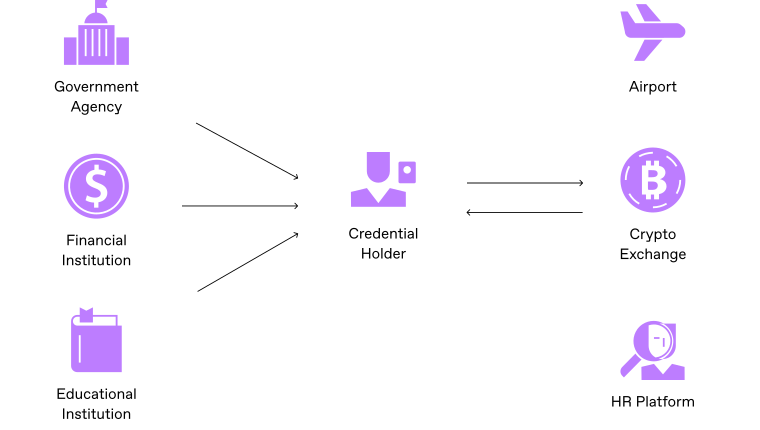
The core mechanism relies on verifiable credentials and zero-knowledge proofs (ZKPs). A user receives a credential from a trusted issuer, such as a government agency or bank, stored securely in their digital wallet. When a service provider needs to verify compliance, the user generates a ZKP. This cryptographic proof demonstrates that a condition is met—such as "the user is over 18" or "the user is not on a sanctions list"—without revealing the birth date or identity number itself. This process ensures that institutions can sync data and guarantee a single, valid record of each client without exposing raw PII.
To maintain security and auditability, the system uses off-chain storage with on-chain anchors. Sensitive documents and credentials are encrypted and stored in decentralized storage networks or private databases, keeping them off the public ledger. However, a cryptographic hash of this data is anchored on-chain. This hash serves as an immutable timestamp and proof of existence, allowing auditors to verify that the data has not been tampered with since issuance. This hybrid approach balances the privacy of off-chain storage with the transparency and immutability required for regulatory compliance.
The market for identity infrastructure reflects the growing demand for these secure, privacy-preserving solutions. Protocols enabling decentralized identity often see correlated activity as institutional adoption increases.
Leading infrastructure providers
The decentralized KYC vaults guide highlights a fragmented but maturing market. As institutions seek to offload liability, several key players have emerged with distinct technical architectures. Understanding their differences in data residency, verification speed, and regulatory alignment is essential for selecting the right infrastructure.
Zyphe: Cryptographic Identity Vaults
Zyphe positions itself as an "audit substrate" for AI and financial applications. Its core offering is a decentralized PII storage layer that keeps personal data off institutional servers. By using cryptographic identity vaults, Zyphe aims to remove personal data from the organization's liability list entirely.
This approach simplifies compliance by ensuring that sensitive information is never stored in a central database vulnerable to breaches. Instead, access is granted via cryptographic proofs, allowing institutions to verify identity without holding the raw data. This model is particularly attractive for firms navigating strict data retention laws.
Intellect EU: Golden Copy Synchronization
Intellect EU focuses on the operational side of KYC: data consistency. Their decentralized KYC solution enables institutions to sync data and documents across a network, guaranteeing a single "golden copy" of each client. When a client updates their information at one institution, the change propagates across the network.
This synchronization eliminates duplicates and ensures that all participants are working with up-to-date information. For legal and regulatory teams, this reduces the risk of acting on stale data and streamlines the onboarding process for clients who interact with multiple entities within the ecosystem.
Comparison of Key Providers
The following table contrasts the primary approaches of leading infrastructure providers. Note that specific technical metrics like verification speed are often proprietary and vary by integration complexity.
| Provider | Core Approach | Data Residency | Regulatory Focus |
|---|---|---|---|
| Zyphe | Cryptographic Identity Vaults | Off-server, decentralized storage | Data retention compliance, AI auditability |
| Intellect EU | Network Synchronization | Distributed across network nodes | Golden copy accuracy, duplicate elimination |
Market trends and adoption signals
The market for decentralized KYC vaults is shifting from experimental pilots to structured integration. This isn't just about avoiding fines; it's about building infrastructure that satisfies regulators without breaking the core promise of decentralized finance. The tension between compliance and decentralization remains the primary friction point, but the tools to bridge that gap are maturing rapidly.
Institutional interest is the strongest signal of this shift. Traditional financial entities are no longer viewing DeFi as an outlier to be blocked, but as a counterpart to be onboarded. They need a way to verify identity that doesn't require storing sensitive personal data in centralized silos. Decentralized KYC vaults offer a solution where credentials are verified once and then shared via zero-knowledge proofs, satisfying AML requirements while preserving user privacy.
This dynamic is reshaping how DeFi protocols approach user acquisition. While many decentralized exchanges still operate without KYC, the regulatory pressure is mounting. Protocols that integrate privacy-preserving compliance early will have a significant advantage in attracting institutional capital. The goal is to strike a balance: maintaining the permissionless nature of the network while ensuring that bad actors can be identified if necessary.
Choosing a vault provider
Selecting a decentralized KYC vault provider is less about picking software and more about transferring liability. In a decentralized identity ecosystem, the vault acts as the custodian of the cryptographic proof. If the provider’s architecture fails or their compliance posture is weak, your institution bears the regulatory fallout. This section outlines the decision framework for evaluating providers, ensuring your infrastructure aligns with both technical needs and legal obligations.
The first filter is legal. Identify where the vault operator is incorporated and where the underlying data shards are stored. A provider operating in a jurisdiction with weak privacy laws or unclear AML directives poses an immediate risk. Ensure the provider explicitly supports your region’s data residency requirements, such as GDPR in Europe or specific state-level privacy laws in the US. If the provider cannot provide a clear data flow map, walk away.
Technical fit hinges on the cryptographic primitives. Not all ZKP implementations are created equal. Evaluate whether the provider uses modern, audited circuits like zk-SNARKs or zk-STARKs. Ask for their latest third-party security audit reports. The goal is to confirm that the vault can prove compliance (e.g., "over 18," "sanctions-free") without revealing the underlying personal data. Weak cryptography undermines the entire value proposition of decentralization.
Compliance is a real-time function. Your onboarding flow cannot stall because the vault provider’s API is down. Review their Service Level Agreements (SLAs) for uptime and latency. Look for providers with redundant infrastructure and clear incident response protocols. A decentralized system is only as reliable as its weakest node; ensure the provider has robust redundancy to handle peak onboarding volumes without dropping verification requests.
Past performance predicts future resilience. Investigate the provider’s history of security incidents. Have they been breached? How quickly did they respond? A provider that hides past vulnerabilities is a liability. Conversely, a provider with transparent incident reports and a clear remediation process demonstrates maturity. Check if they have a bug bounty program and whether independent auditors regularly review their smart contracts and backend infrastructure.
| Feature | Vendor A | Vendor B |
|---|---|---|
The right provider integrates seamlessly into your existing compliance stack while shielding sensitive data. Prioritize transparency and cryptographic rigor over flashy marketing. A decentralized KYC vault is only as strong as its legal and technical foundations.
Common questions about decentralized KYC
Understanding how decentralized identity infrastructure works requires separating the technology from the regulatory obligations. Below are answers to the most frequent queries regarding this emerging standard.
No comments yet. Be the first to share your thoughts!