What decentralized kyc vaults actually do
Traditional KYC operates on a fragile premise: you upload your passport to a central database, and a third party holds the keys. If that database is breached, your identity is compromised across every platform you use. Decentralized KYC vaults solve this by splitting the process. They separate identity verification from data storage, ensuring that raw Personally Identifiable Information (PII) never touches your service provider's servers.
In a decentralized model, you verify your identity with a trusted issuer once. That issuer generates a cryptographic proof—a digital signature confirming you are over 18, or that you are from a specific jurisdiction—without revealing the underlying document. You store this proof in your own digital wallet. When a service requires verification, you present only the proof, not the passport itself. This architecture removes the single point of failure that makes traditional KYC such a liability.
The infrastructure supporting this shift is gaining traction. While the broader crypto market fluctuates, the underlying technology stack for decentralized identity is becoming more robust, with providers like Dock and Zyphe building specialized layers for privacy-preserving verification.
This separation of concerns means that if a platform is hacked, the attacker finds nothing but useless encrypted hashes. The raw data remains secure in your wallet or a decentralized storage network. For regulated entities, this reduces compliance overhead and liability, aligning with the FATF’s growing emphasis on privacy by design in digital identity frameworks.
Regulatory and Market Forces Driving Adoption
The push for decentralized KYC vaults is no longer just a compliance preference; it is a structural necessity. Two major regulatory frameworks are reshaping how institutions interact with on-chain assets: the European Union’s Markets in Crypto-Assets (MiCA) regulation and the Financial Action Task Force (FATF) Travel Rule. MiCA introduces strict transparency requirements for stablecoin issuers and service providers, effectively mandating robust identity verification mechanisms for any entity operating within the EU market. Simultaneously, the FATF’s Travel Rule extends traditional banking compliance obligations to virtual asset service providers (VASPs), requiring them to share originator and beneficiary information for transactions above certain thresholds. For decentralized protocols, meeting these standards without sacrificing the core ethos of permissionless access requires a new infrastructure layer—specifically, privacy-preserving compliance vaults.
Institutional DeFi is the other major driver. As traditional finance moves toward tokenization, it demands infrastructure that mirrors the security and governance standards of TradFi. Institutional vaults are not simple storage mechanisms; they are structured products that incorporate access controls, KYC whitelisting, and on-chain governance to ensure only verified participants can interact with specific pools of capital. This shift is creating a market for "compliance-ready" DeFi primitives that can prove user identity through zero-knowledge proofs or selective disclosure, allowing institutions to participate in yield-generating strategies while remaining audit-ready for regulators.
To understand the broader market context in which these vaults operate, it is helpful to look at the performance of the underlying DeFi ecosystem. The correlation between regulatory clarity and institutional capital inflow is visible in market trends.
The infrastructure required to support this shift is evolving rapidly. Below is a comparison of how traditional KYC methods stack up against decentralized vault architectures in terms of data handling and user experience.
| Feature | Traditional KYC | Decentralized KYC Vault |
|---|---|---|
| Data Storage | Centralized database | Distributed/Off-chain |
| User Privacy | Minimal (full data shared) | High (zero-knowledge proofs) |
| Compliance Audit | Manual/Periodic | Automated/Real-time |
| Interoperability | Low (siloed) | High (cross-protocol) |
For legal and compliance teams evaluating this technology, the transition involves more than just adopting new software. It requires a shift in how identity is managed and verified. The following checklist outlines the critical steps for integrating decentralized KYC vaults into existing compliance frameworks:
-
Identify regulatory jurisdictions where MiCA or FATF rules apply to your operations.
-
Select a decentralized KYC provider that supports selective disclosure and zero-knowledge proofs.
-
Implement on-chain attestation layers that link verified identities to wallet addresses without exposing PII.
-
Establish automated monitoring for ongoing due diligence and risk assessment.
-
Test interoperability with existing DeFi protocols to ensure seamless user onboarding.
Comparing vault infrastructure models
Building a Decentralized KYC Vaults system requires choosing a foundational architecture. The three dominant models—Verifiable Credentials (VCs), Zero-Knowledge Proofs (ZKPs), and Decentralized Identifiers (DIDs)—serve different roles in the compliance stack. Understanding their distinct strengths is essential for aligning technical infrastructure with regulatory expectations.
| Model | Privacy Level | Computational Cost | Regulatory Acceptance |
|---|---|---|---|
| Verifiable Credentials (VCs) | Standard (data shared) | Low | High |
| Zero-Knowledge Proofs (ZKPs) | Maximum (proof only) | High | Emerging |
| Decentralized Identifiers (DIDs) | User-controlled | Low | Standard |
Verifiable Credentials (VCs) act as the digital equivalent of a physical passport or license. Issued by trusted entities, these credentials are stored in user wallets and presented to verifiers when needed. This model offers the highest regulatory acceptance because it allows auditors to see the actual data points required for compliance, such as age or jurisdiction. However, this transparency comes at the cost of privacy; every verification request exposes the underlying data to the verifier.
Zero-Knowledge Proofs (ZKPs) represent the privacy-first approach. Instead of sharing the actual identity data, the user generates a cryptographic proof that they meet specific criteria—such as being over 18 or residing in a sanctioned-free zone—without revealing who they are. While this offers maximum privacy, the computational cost is significantly higher, and regulatory bodies are still developing frameworks to accept ZKP-based compliance as legally sufficient.
Decentralized Identifiers (DIDs) provide the underlying structure for self-sovereign identity. They allow users to own and control their digital identities without relying on centralized authorities. DIDs are often used in conjunction with VCs, acting as the anchor for the credentials. This model balances privacy and utility by giving users control over their identity data, though it requires more complex infrastructure to manage key recovery and revocation.

Choosing the right model depends on your specific risk tolerance and target market. For traditional financial institutions, VCs offer the path of least resistance. For privacy-focused Web3 applications, ZKPs may be the only viable option. Many modern Decentralized KYC Vaults combine all three: using DIDs for identity management, VCs for standard compliance, and ZKPs for sensitive data protection.
Key vendors and protocol options
The decentralized KYC vaults market has matured from experimental protocols to production-ready infrastructure. This section highlights the leading platforms shaping the landscape, focusing on their specific value propositions and technical approaches. Understanding these options helps legal and compliance teams evaluate which solutions align with regulatory requirements and operational needs.
Zyphe: Cryptographic PII Vaults
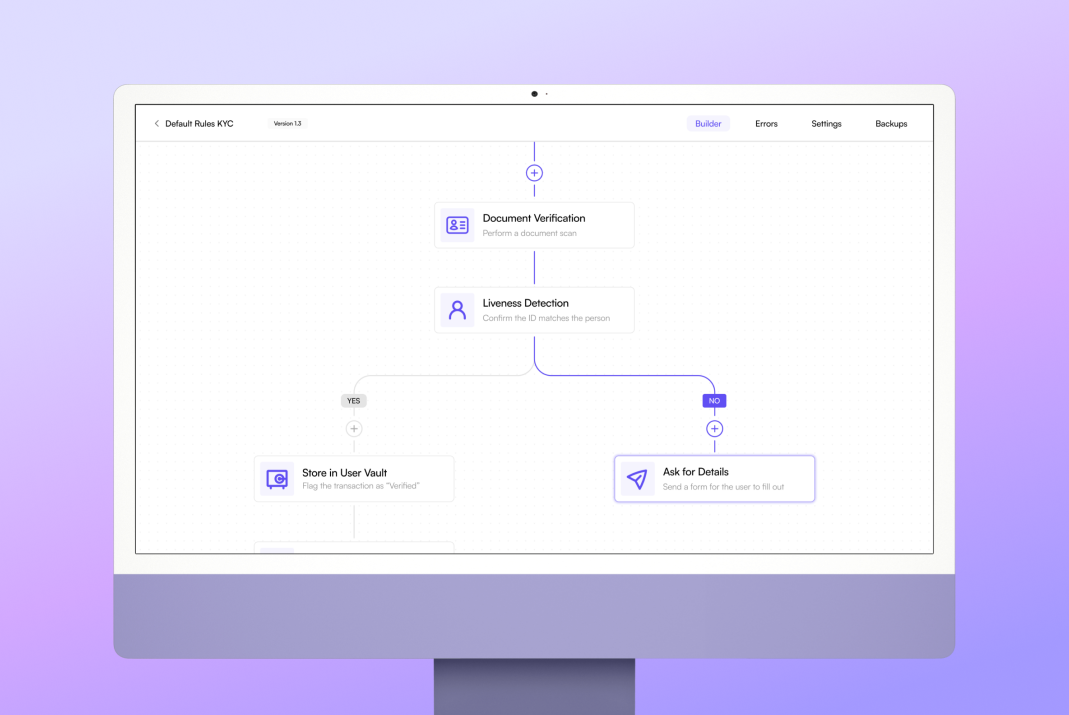
Zyphe focuses on cryptographic identity vaults that keep personal data off central servers. Their approach removes the liability of storing sensitive information directly, reducing the attack surface for breaches. The platform uses advanced cryptography to ensure data remains secure while still allowing for verification. This model appeals to organizations seeking to minimize data retention risks.
Dock: Verifiable Credentials Infrastructure
Dock provides a robust framework for issuing and managing verifiable credentials. Their protocol supports W3C standards, ensuring interoperability across different platforms and jurisdictions. Dock’s infrastructure is designed for enterprises needing scalable identity solutions that comply with global regulations. Their focus on standardization makes them a strong choice for cross-border compliance.
Market Context
The growth of decentralized identity solutions is closely tied to broader crypto market trends. Tracking the performance of related assets can provide context for investment and adoption trends in this sector.
Infrastructure Comparison
Choosing the right vendor depends on specific technical and compliance needs. The table below compares key features of leading platforms to aid in decision-making.
| Vendor | Primary Focus | Standards Compliance | Data Liability Model |
|---|---|---|---|
| Zyphe | Cryptographic PII Vaults | Proprietary | Minimal (Off-server) |
| Dock | Verifiable Credentials | W3C VC | Shared (Issuer/Verifier) |
| Sovrin | Decentralized Identifiers | W3C DID | User-Centric |
Actionable Advice for Implementation
Before integrating a decentralized KYC vault, consider these critical steps to ensure compliance and security.
-
Verify regulatory alignment with local jurisdictions
-
Conduct a thorough security audit of the vendor
-
Ensure interoperability with existing systems
-
Plan for user onboarding and education
-
Define clear data retention and deletion policies
Frequently asked: what to check next
Choosing the right vault for your use case
Selecting a decentralized KYC vault requires balancing regulatory compliance with user privacy. The infrastructure you build depends on your risk tolerance, user base, and jurisdiction. Below is a framework to guide your decision.
Your legal obligations dictate the vault’s architecture. If you operate in the EU, GDPR’s right to erasure conflicts with immutable blockchain ledgers. You may need a zero-knowledge proof (ZKP) vault to verify identity without storing raw data. For US-based entities, FATF Travel Rule compliance may require stricter data residency checks.
Institutional users often accept higher friction for deeper compliance, such as full identity verification via providers like Dock or Zyphe. Retail users demand seamless experiences. Consider a hybrid model: on-chain verification for high-value transactions and off-chain storage for low-risk interactions to reduce friction.

Not all vaults are created equal. Some store verification credentials on-chain, while others use decentralized storage solutions like IPFS with encrypted keys. Ensure your provider supports your jurisdiction’s data laws. Look for infrastructure that allows you to audit data access logs and maintain control over credential revocation.
| Feature | On-Chain Storage | Off-Chain Storage | Zero-Knowledge Proof |
|---|---|---|---|
| Privacy | Low | Medium | High |
| Compliance | High | Medium | Medium |
| Cost | High | Low | Medium |
-
Verify data residency compliance with local laws
-
Audit verification provider for regulatory approval
-
Implement user consent and revocation flows
-
Set up fallback mechanisms for failed verifications
Frequently asked questions about decentralized KYC
Understanding how decentralized identity stacks up against traditional compliance frameworks is essential for navigating the 2026 regulatory landscape. Below are the most common queries regarding verification stages, exchange requirements, and structural layers.
These questions highlight the tension between user privacy and regulatory mandates. While DEXs often remain no-KYC by design, the underlying infrastructure is increasingly integrating verification tools to satisfy FATF guidelines and prevent illicit flows.
No comments yet. Be the first to share your thoughts!