Decentralized kyc vaults limits to account for
The core constraint of decentralized KYC is balancing regulatory compliance with data sovereignty. Traditional systems store Personally Identifiable Information (PII) in centralized databases, creating single points of failure for breaches. Decentralized KYC shifts this model by placing credentials in user-owned vaults. This architecture allows users to control who accesses their data and for how long.
This shift introduces a significant operational tradeoff. While it eliminates the risk of mass data leaks, it complicates the verification process for regulated entities. Compliance teams must now trust cryptographic proofs rather than direct database access. This requires new infrastructure to validate zero-knowledge proofs without seeing the underlying data. The result is a system where privacy is preserved, but the burden of verification moves upstream to the user.
For businesses, this means adopting a "verify, don't store" approach. Instead of holding copies of passports or utility bills, institutions verify the validity of the credential against the issuer's public key. This reduces liability and storage costs but demands robust integration with identity providers. The constraint is not technical feasibility but the friction of user adoption and the complexity of cross-chain identity resolution.
Evaluating Decentralized KYC Vaults
Choosing a decentralized KYC solution requires balancing compliance rigor against user privacy and technical complexity. The tradeoffs are rarely binary; they exist on a spectrum of data control and verification speed. You must evaluate how each platform handles the tension between regulatory requirements and the core Web3 promise of self-sovereign identity.
Data Sovereignty vs. Verification Speed
The primary value proposition of decentralized KYC is that users retain ownership of their credentials in personal vaults rather than centralized corporate databases. This shift eliminates the risk of massive PII breaches but introduces latency. AI verification agents must query these vaults in real-time, which can slow down onboarding compared to traditional centralized checks. For high-volume exchanges, this speed penalty is a significant operational cost. For privacy-focused platforms, it is the defining feature.
Compliance Granularity and Jurisdictional Reach
Not all decentralized vaults offer the same level of regulatory detail. Some platforms provide simple "pass/fail" status updates, while others allow granular data sharing (e.g., sharing only age verification without revealing identity documents). This granularity matters for global compliance. A vault that supports complex jurisdictional rules enables platforms to serve users across different legal frameworks without storing redundant data. Evaluate whether the vault supports the specific regulatory regimes your platform operates in, such as EU MiCA or US FinCEN guidelines.
Technical Integration and Interoperability
The ease of integrating a decentralized KYC vault into your existing stack determines its practical utility. Solutions that rely on proprietary standards create vendor lock-in, making it difficult to switch providers or onboard users from other platforms. Look for implementations that leverage open standards like W3C Verifiable Credentials. Interoperability ensures that a user verified on one platform can potentially reuse their credentials elsewhere, reducing friction for the end-user and increasing adoption rates for the verification provider.
Cost Structure and Scalability
Traditional KYC providers often charge per-check fees that scale linearly with user growth. Decentralized models may involve gas fees for on-chain verification or subscription-based access to AI agent networks. These costs can be lower at scale but require careful calculation during the initial design phase. Consider whether the cost model aligns with your user base's tolerance for transaction fees or subscription costs. A transparent, predictable cost structure is essential for long-term sustainability.
| Feature | Centralized KYC | Decentralized KYC | Hybrid Model |
|---|---|---|---|
| Data Storage | Company Servers | User Vaults | Split Storage |
| Breach Risk | High (Single Point) | Low (Distributed) | Medium |
| User Control | Low | High | Medium |
| Integration Speed | Fast | Slower | Medium |
| Compliance Depth | High | Variable | High |
How to choose a decentralized KYC vault provider
Selecting a decentralized KYC provider requires balancing user privacy with regulatory compliance. The goal is to find a system where you own your credentials, not the platform. This approach shifts personal data from company databases into user-owned vaults, eliminating the risk of centralized PII leaks.
Use this four-step framework to evaluate providers. Focus on verification methods, data ownership models, and integration ease.
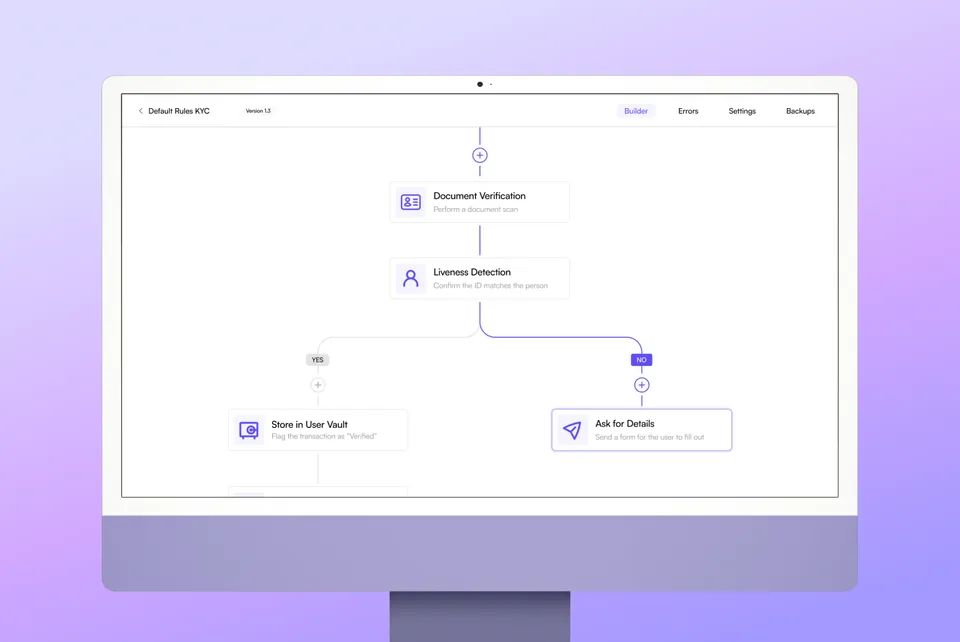
Check if the provider uses W3C Verifiable Credentials. This open standard ensures interoperability across different platforms. Avoid proprietary systems that lock your identity data into a single ecosystem. Standardized credentials allow you to reuse verification across multiple services without repeating the process.
Ensure the vault uses zero-knowledge proofs (ZKPs). This technology allows you to prove you are over 18 or a resident of a specific country without revealing your actual birthdate or address. Providers that store raw biometric data on-chain or in cloud databases fail this critical privacy test.
A good provider offers a seamless experience. Look for AI verification agents that can process documents quickly. The interface should be intuitive for non-technical users. If the onboarding takes more than five minutes or requires complex wallet management, the friction will hurt adoption.
Verify that the provider meets AML and CFT requirements in your jurisdiction. Even decentralized systems must support travel rule compliance for high-value transactions. Ask for documentation on how they handle law enforcement requests while maintaining user privacy. Reputable providers publish clear compliance policies.
TLDR; Prioritize W3C standards and zero-knowledge proofs. Ensure the provider balances strict regulatory compliance with genuine user data ownership.
Spotting Weak Decentralized KYC Options
Not all decentralized KYC solutions offer the privacy or compliance guarantees they promise. Many platforms still rely on centralized servers for verification, creating a single point of failure that defeats the purpose of user-owned vaults. When evaluating infrastructure, look for solutions that use zero-knowledge proofs to verify identity without exposing raw personal data.
Be wary of projects that claim full decentralization but store sensitive documents on public blockchains. This is a critical compliance error, as it violates GDPR and other privacy regulations. Strong options keep PII off-chain while storing only cryptographic proofs on-chain. This ensures that even if the blockchain is transparent, your identity remains private.
Another common mistake is ignoring the verification agent layer. Some systems use outdated manual review processes instead of AI agents, slowing down onboarding and increasing costs. Efficient decentralized KYC should automate verification through secure, privacy-preserving protocols. Always check if the provider offers clear documentation on how they handle data breaches and regulatory audits before committing.
Decentralized kyc vaults: common: what to check next
Decentralized KYC uses AI verification agents and user-owned vaults to shift personal data away from company databases, eliminating the need to store PII in centralized servers. This architecture allows institutions to sync documents while maintaining a single, golden copy of client data without exposing raw credentials.
What are the three layers of KYC?
Standard compliance relies on three distinct verification stages:
- Customer Identification Program (CIP): Verifying the individual’s identity using government-issued documents.
- Customer Due Diligence (CDD): Assessing the risk profile and purpose of the business relationship.
- Enhanced Due Diligence (EDD): Applying deeper scrutiny to high-risk accounts or complex ownership structures.
How to complete KYC on crypto?
To complete KYC on a crypto platform, users typically upload a government-issued ID and a selfie for facial recognition. Many decentralized vaults now allow you to verify once and reuse that credential across multiple services, reducing repeated data exposure.
What are the four steps of the KYC process?
The process follows a strict sequence:
- Data Collection: Gathering names, addresses, and ID details.
- Verification: Validating documents against authoritative sources.
- Screening: Checking against sanctions and watchlists.
- Monitoring: Ongoing surveillance of transaction patterns for anomalies.
No comments yet. Be the first to share your thoughts!