What decentralized KYC vaults actually do
Decentralized KYC shifts the storage of personally identifiable information (PII) from centralized company databases into user-owned vaults. This architectural change allows for reusable verification, meaning a user can verify their identity once and share the result with multiple institutions without re-uploading documents or exposing raw data to every new platform.
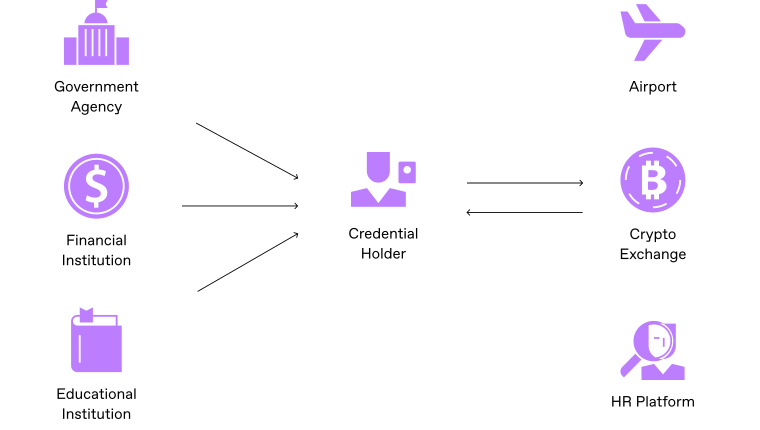
In this model, the vault acts as a secure container for your credentials. When an institution needs to verify your identity, it does not receive your passport or address directly. Instead, it receives a cryptographic proof that the data in the vault matches a trusted source. This process ensures that the institution can confirm your identity without ever holding, storing, or being liable for your raw personal information.
This approach also solves the problem of data fragmentation. By creating a single, golden copy of each client and associated natural persons, decentralized systems enable institutions to sync data and documents across a network. Whenever a client is onboarded or their data is updated at one institution, that update can be reflected across the network, ensuring data remains current while eradicating duplicates.
For legal and compliance teams, this separation of duty is significant. It reduces the attack surface for data breaches and simplifies adherence to regulations like GDPR, which emphasize data minimization. The user retains control over who accesses their data and for how long, while the institution gains a reliable, verified identity signal without the burden of long-term data custody.
Infrastructure layers for compliant identity
Decentralized KYC (dKYC) shifts the burden of data management from centralized silos to a user-controlled vault. Instead of storing raw personal identifiable information (PII) in vulnerable databases, institutions rely on a technical stack that verifies credentials without exposing the underlying data. This architecture satisfies regulatory requirements by ensuring that sensitive information remains with the user while still providing auditable proof of compliance.
Verification and Storage
The foundation of this system is the decentralized identity (DID) framework. Users hold their verified credentials in a personal digital wallet, often referred to as a KYC vault. When an institution needs to verify a client, the user shares a cryptographic proof rather than a copy of their passport or utility bill. This process creates a "golden copy" of the client’s data, ensuring that institutions can sync documents and guarantee accuracy without maintaining duplicate records.
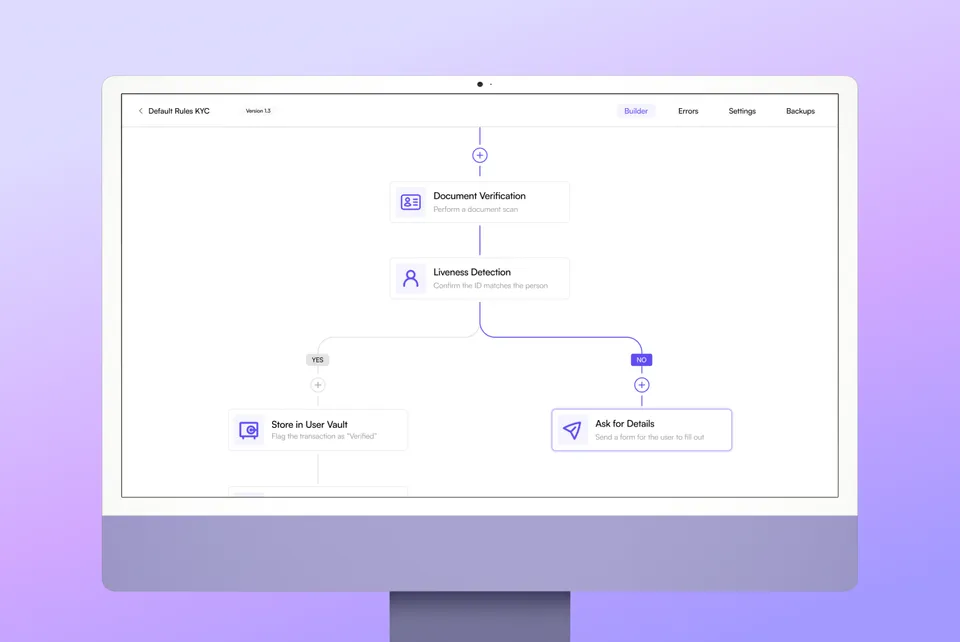
As shown in the diagram below, the workflow prioritizes user ownership of credentials. The verification step happens off-chain or via zero-knowledge proofs, meaning the actual sensitive data never touches the public ledger. This separation is critical for privacy laws like GDPR, which mandate that data minimization is practiced at every step of the onboarding process.
On-Chain Attestations
Once verification is complete, the result is recorded as an on-chain attestation. These are not raw data records but rather signed statements from trusted issuers (such as banks or government agencies) confirming that a user has passed specific checks. Smart contracts can then read these attestations to grant access to services, such as opening a bank account or trading on a regulated exchange.
This layer ensures that compliance is transparent and immutable. Regulators can audit the attestation logic without seeing the user’s private data. By decoupling verification from storage, the infrastructure reduces the attack surface for data breaches, which is the primary liability in traditional KYC models. The result is a system where compliance is automated, secure, and user-centric.
Comparing leading vault providers
Decentralized KYC Vaults works best as a clear sequence: define the constraint, compare the realistic options, test the tradeoff, and choose the path with the fewest hidden costs. That order keeps the advice usable instead of decorative. After each step, pause long enough to check whether the recommendation still fits the reader's actual situation. If it depends on perfect timing, unusual access, or a best-case budget, include a simpler fallback.
| Factor | What to check | Why it matters |
|---|---|---|
| Fit | Match the option to the primary use case. | A good deal still fails if it does not fit the job. |
| Condition | Verify age, wear, and service history. | Hidden condition issues erase upfront savings. |
| Cost | Compare purchase price with likely upkeep. | The cheapest option is not always the lowest-cost option. |
Navigating regulatory requirements
Decentralized KYC vaults solve a specific compliance paradox: regulators demand proof of identity, but users refuse to hand over their data to centralized servers. The solution lies in shifting from raw data storage to cryptographic proof. Instead of holding a passport image, a vault generates a zero-knowledge proof (ZKP) that confirms a user meets specific criteria—such as being over 18 or residing in a permitted jurisdiction—without revealing the underlying personal information.
This architecture directly addresses the European Union’s Markets in Crypto-Assets (MiCA) regulation, which requires strict travel rule compliance for virtual asset service providers. Under MiCA, institutions must verify the origin and destination of funds. A decentralized vault allows a service provider to request a "compliant" status from the vault. The vault checks its encrypted records and returns a signed token confirming compliance. The provider can then proceed with the transaction, confident that the regulatory audit trail exists, even though they never saw the user’s actual identity documents.
The same mechanism satisfies the Financial Crimes Enforcement Network (FinCEN) guidelines in the United States. The Travel Rule mandates that financial institutions share sender and recipient information for transactions above a certain threshold. By using a decentralized identity (DID) standard, the vault can securely transmit the necessary travel rule data to the receiving institution in a machine-readable format. This ensures that the audit trail is complete and immutable, satisfying anti-money laundering (AML) checks while keeping the user’s private keys and sensitive data out of the provider’s hands.
The result is a system where compliance is a feature of the infrastructure, not an afterthought. Regulators get the transparency they need to enforce laws, and users get the privacy they expect from decentralized systems. The vault acts as a trusted intermediary that validates identity without becoming a single point of failure or a target for mass data breaches.
Choosing the right identity strategy
Institutions must decide whether to build proprietary decentralized KYC vaults or integrate existing solutions. This decision hinges on three factors: regulatory jurisdiction, technical infrastructure, and the need for cross-border data synchronization.
Determine if your target markets accept decentralized identity proofs. Major regulators like the EU (MiCA) and Singapore (MAS) are increasingly recognizing decentralized identifiers (DIDs), while other jurisdictions remain restrictive. Verify which KYC providers have explicit regulatory approval in your operating regions before committing to a build strategy.

Decentralized KYC vaults offer superior data sovereignty by keeping sensitive personal information encrypted and user-controlled. If your business model relies on minimizing liability for data breaches, a proprietary vault strategy may reduce your attack surface. However, this requires significant investment in cryptographic infrastructure and key management.
Existing KYC providers like Sumsub or Trulioo offer plug-and-play APIs that accelerate time-to-market. Building a proprietary vault requires integrating with multiple identity providers and managing complex verification workflows. For most institutions, integrating a reputable third-party decentralized KYC solution offers a faster, lower-risk path to compliance.
The choice ultimately depends on your balance between control and speed. If you need immediate global coverage, integration is the pragmatic choice. If data privacy is your primary competitive advantage, building a vault may be worth the long-term investment.
Common questions about decentralized identity
Decentralized KYC shifts the burden of data management from individual institutions to a shared, verified network. Instead of each entity maintaining its own siloed records, the system synchronizes documents to guarantee a single, "golden copy" of each client and associated natural persons. This architecture ensures data remains current across the network while eradicating duplicates during onboarding or updates Intellect EU.
No comments yet. Be the first to share your thoughts!