What Decentralized KYC Vaults Do
Decentralized KYC vaults shift the burden of data custody from institutions to the individual. Instead of a bank or exchange storing your passport scan in a central database, you hold the verifiable credentials in your own digital wallet. The vault acts as a secure container, releasing only the specific proof needed for a transaction—such as "over 18" or "sanctions-free"—rather than handing over your entire identity file.
This architecture resolves the tension between regulatory compliance and user privacy. Traditional KYC processes require organizations to hoard sensitive personal data, creating high-value targets for hackers and increasing liability for data breaches. With decentralized identity, the verification is cryptographically proven without exposing the underlying raw data. As noted by Entrust, this model allows financial institutions to share KYC information securely and cost-effectively, reducing redundant checks while maintaining audit trails.
For the user, this means identity reuse. Once you have verified your identity with a trusted issuer, that credential lives in your vault. You can present it to multiple platforms without undergoing repetitive onboarding flows. The system verifies the signature of the issuer, not the content of the document, ensuring that your personal details remain private while the institution remains compliant with anti-money laundering (AML) standards.
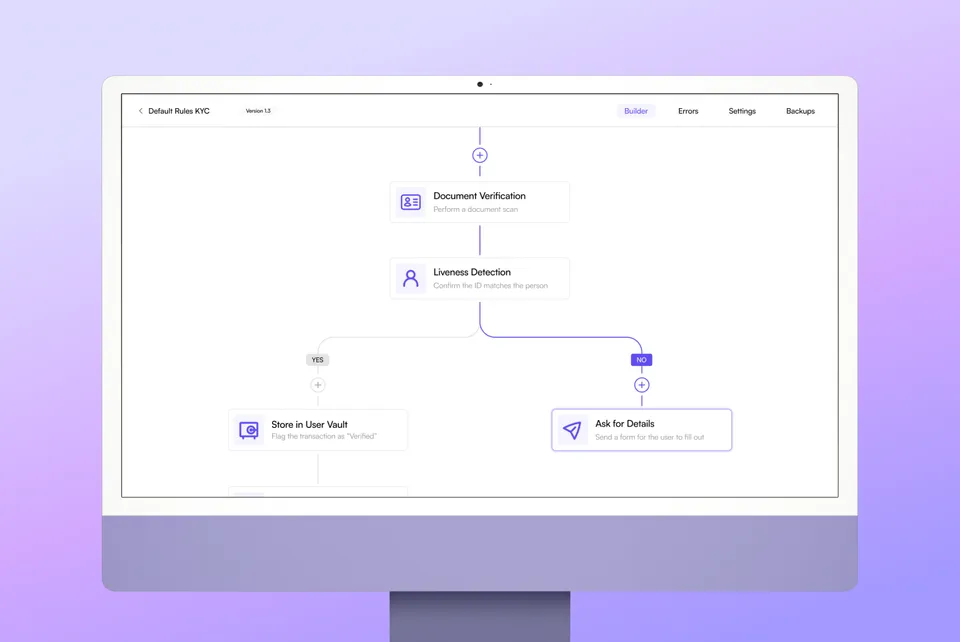
Choose the right verification infrastructure
Selecting the technical stack for your Decentralized KYC Vaults guide requires balancing privacy preservation with regulatory compliance. You need infrastructure that verifies user identity without storing raw Personally Identifiable Information (PII) on-chain or in centralized databases. The goal is to build a system where users control their credentials, allowing them to reuse verified identities across different platforms.
Evaluate zero-knowledge proof (ZK) providers
Zero-knowledge proofs are the cornerstone of privacy-preserving verification. They allow you to prove that a user meets specific criteria (e.g., age > 18, wallet not sanctioned) without revealing the underlying data. When choosing a ZK provider, prioritize those with mature toolkits and active community support. Look for solutions that offer efficient proof generation times, as this directly impacts user experience. Ensure the provider supports the specific cryptographic primitives your vault architecture requires, such as SNARKs or STARKs, depending on your latency and security needs.
Select decentralized identifier (DID) standards
Decentralized Identifiers (DIDs) provide the framework for managing identity without a central authority. The choice of DID method determines how credentials are issued, stored, and verified. Popular options include W3C-compliant standards like DIDComm and DIDCore. Consider the interoperability of the DID standard with existing identity providers and wallets. A robust DID infrastructure ensures that your vault can verify credentials from multiple issuers, creating a flexible and resilient ecosystem.
Integrate oracle networks for data verification
Oracles bridge the gap between off-chain data and on-chain verification. For KYC purposes, oracles can fetch and verify real-world data points, such as credit scores or legal status, without exposing the raw data to the blockchain. Choose oracle networks that offer high reliability and security, as they are critical for maintaining the integrity of the verification process. Ensure the oracle supports the specific data sources required by your compliance framework.
| Component | Privacy Level | Compliance Support | Latency |
|---|---|---|---|
| ZK-SNARKs | High | Moderate | Medium |
| ZK-STARKs | Very High | Moderate | High |
| DIDComm | High | High | Low |
| Oracle Networks | Variable | High | Low |


As an Amazon Associate, we may earn from qualifying purchases.
Deploy the vault with compliance rules
Integrating a Decentralized KYC Vaults guide into your dApp requires mapping user identity to on-chain actions without exposing raw personal data. You must configure the vault to satisfy MiCA and Travel Rule requirements while keeping the user experience frictionless. This process turns abstract regulatory text into executable smart contract logic.
1. Define verification criteria
Start by mapping your regulatory obligations to specific data points. Under MiCA, you need to distinguish between low-risk and high-risk transactions to determine when a full identity check is mandatory. Use this mapping to set the threshold for your Decentralized KYC Vaults guide integration. If a transaction exceeds your defined limit, the system triggers a vault pull; otherwise, it proceeds with a lighter proof.
2. Integrate identity oracle
Connect your smart contracts to a decentralized identity oracle that can verify credentials without storing PII on-chain. The oracle acts as the bridge between off-chain identity providers (like government ID checks) and your on-chain logic. When a user submits credentials, the oracle issues a zero-knowledge proof to the vault. This ensures that your platform only sees a "verified" status, not the user’s passport number.
3. Configure vault access
Set up the access control lists (ACLs) within the vault. You need to define which entities can request data and under what conditions. For example, a compliance officer or an automated AML screen should have read-only access to the verification proof, but never the underlying document. This configuration ensures that the Decentralized KYC Vaults guide principles of data minimization are technically enforced.
4. Test compliance flow
Run end-to-end tests simulating both compliant and non-compliant user journeys. Verify that the vault rejects access requests that do not match the predefined criteria. Test edge cases where a user’s identity expires or where a transaction triggers a Travel Rule requirement for cross-border transfers. This step confirms that your infrastructure holds up under regulatory scrutiny.
Avoid privacy and legal pitfalls
Building a Decentralized KYC Vaults guide requires more than just smart contract logic; it demands strict adherence to data protection laws. The infrastructure you design will either shield user identity or expose it to liability. Below are the most common mistakes teams make when handling sensitive verification data, along with the technical fixes required to stay compliant.
Don't store raw PII on-chain
The most frequent error is uploading scanned IDs, passport numbers, or selfie images directly to a blockchain or public IPFS pin. Even if the data is encrypted, the metadata and access logs can create a permanent, unalterable record that violates the "right to be forgotten" under GDPR. A Decentralized KYC Vaults guide must emphasize that the vault should only store a cryptographic commitment (hash) or a ZK-proof of eligibility. The actual sensitive documents should remain in a secure, off-chain, GDPR-compliant database with strict access controls.
Ignoring jurisdictional variances
KYC regulations vary wildly between the EU, US, and Asia. A one-size-fits-all approach often leads to non-compliance. For instance, the EU's GDPR imposes heavy fines for data breaches, while the US focuses more on AML reporting. Your vault architecture must support jurisdictional tagging, allowing you to apply different retention policies and access rules based on the user's location. Failing to implement this geographic logic can result in legal penalties that outweigh the benefits of decentralization.
Failing to implement revocation
Identity is not static. Users change names, lose access to devices, or request account deletion. If your system lacks a robust revocation mechanism, you risk storing obsolete or compromised credentials indefinitely. Implement a clear off-chain revocation list or a smart contract-based status update system. This ensures that if a user withdraws consent or is flagged for fraud, their verified status is immediately invalidated across all dependent protocols.
FAQs about decentralized KYC vaults
What is decentralized KYC?
Decentralized KYC shifts identity verification from centralized databases to user-controlled vaults. Instead of uploading documents to every platform, users verify their identity once with an accredited provider and store the credential in a secure vault. Subsequent platforms request a zero-knowledge proof to confirm compliance without storing raw personal data. This model gives users ownership of their credentials and reduces the attack surface for data breaches.
What are the 4 pillars of KYC?
Regulatory compliance rests on four core pillars: Customer Identification Program (CIP), Customer Due Diligence (CDD), Enhanced Due Diligence (EDD), and ongoing monitoring. CIP verifies the legal identity of the user. CDD assesses the risk profile based on transaction history. EDD applies to high-risk customers or jurisdictions. Ongoing monitoring ensures the profile remains accurate as regulations or user behavior changes.
How to complete KYC on crypto?
Completing KYC on a crypto exchange typically follows a standard workflow. First, create an account and enter your personal details. Second, upload government-issued ID and a selfie for facial recognition. Third, answer source-of-funds questions if required. The platform reviews these documents, often using AI agents for initial screening. Once approved, your vault is linked, allowing you to reuse the verified status across other supported services.
What are the top 10 KYC companies?
The decentralized KYC landscape includes providers like Jumio, Onfido, and Sumsub, which offer traditional verification services. Newer entrants like Zyphe focus specifically on decentralized credential management. The "top" provider depends on your integration needs: legacy banks may prefer established firms with broad regulatory coverage, while Web3 projects may prioritize SDKs that support zero-knowledge proofs and user-centric data storage.
Work through to Decentralized KYC Vaults
No comments yet. Be the first to share your thoughts!