What a decentralized KYC vault actually is
A decentralized KYC vault is a privacy-preserving storage layer that sits between the user and the verifier. Instead of sending raw identity documents to every platform you interact with, you store your credentials in a secure, user-controlled vault. This architecture fundamentally shifts the burden of data management from institutions back to individuals, addressing the fragmentation that plagues traditional onboarding.
The primary advantage is the use of zero-knowledge proofs (ZKPs). When a service needs to confirm your age or residency, the vault generates a cryptographic proof that satisfies the requirement without revealing the underlying document. This means the verifier never sees your passport, only a mathematical confirmation that the data is valid and unaltered. This distinction is critical for high-stakes financial and legal compliance, where data minimization is not just a best practice but a regulatory necessity.
Traditional centralized databases create single points of failure and massive honeypots for attackers. By contrast, decentralized KYC vaults eliminate the need for redundant data collection. As noted by IntellectEU, this approach allows institutions to sync data and documents while guaranteeing a single, golden copy of each client. You verify once, and the vault manages the reuse of those verified credentials across platforms, reducing friction and exposure.
Who controls the vault? Market landscape and key providers
The decentralized KYC vault market is shifting from a niche experiment to a core infrastructure layer for Web3 and Web2 fintech. The competitive advantage no longer lies in who can verify a passport fastest, but who can guarantee data sovereignty while maintaining regulatory compliance. In 2026, the market is dominated by three distinct architectural approaches: credential ownership, institutional synchronization, and developer-first identity standards.
Entrust leads the legacy-to-decentralized transition. By integrating traditional identity verification with blockchain-backed credential issuance, Entrust appeals to institutions that cannot compromise on regulatory audit trails. Their model prioritizes data integrity, ensuring that once a user is verified, that single source of truth is securely shared across the network without redundant re-verification. This approach minimizes friction for high-stakes financial onboarding while keeping the user's personal data encrypted and off-chain.
Dock focuses on the developer ecosystem and decentralized identity (DID) standards. Their infrastructure is built for interoperability, allowing platforms to issue verifiable credentials that users can store in their own digital wallets. Dock’s strength lies in its flexibility; it provides the tools for any application to become a decentralized KYC vault, making it a preferred choice for startups and DeFi protocols that need to build custom compliance flows without reinventing the cryptographic wheel.
IntellectEU targets the institutional sync problem. Their Catalyst Blockchain Manager enables banks and regulated entities to maintain a synchronized, immutable record of client identities across a consortium. Rather than focusing on individual user wallets, IntellectEU builds the secure pipes that allow trusted institutions to share verification status. This is critical for cross-border finance, where a client verified by one bank needs to be instantly recognized by a partner institution without exposing raw personal data.
Infrastructure Comparison
The table below contrasts the primary value propositions of these three market leaders. Choosing the right provider depends on whether your priority is regulatory legacy integration, developer flexibility, or institutional consortium sync.
| Provider | Core Model | Best For | Data Ownership |
|---|---|---|---|
| Entrust | Legacy-Blockchain Hybrid | Regulated Fintech | Institution-Guaranteed |
| Dock | Developer DID Standards | DeFi & Startups | User-Centric Wallet |
| IntellectEU | Consortium Sync | Cross-Border Banking | Network-Synced |
How the vault stores and verifies data
A decentralized KYC vault operates as a privacy-preserving storage layer that sits between the user and the verifier. Instead of sending raw identity documents to every institution, the user stores a single, golden copy of their data. This architecture ensures that data remains up-to-date while eradicating duplicates across the network.
The workflow follows a strict three-part sequence: issuance, storage, and verification. Each step relies on cryptographic primitives to maintain security without sacrificing regulatory compliance.
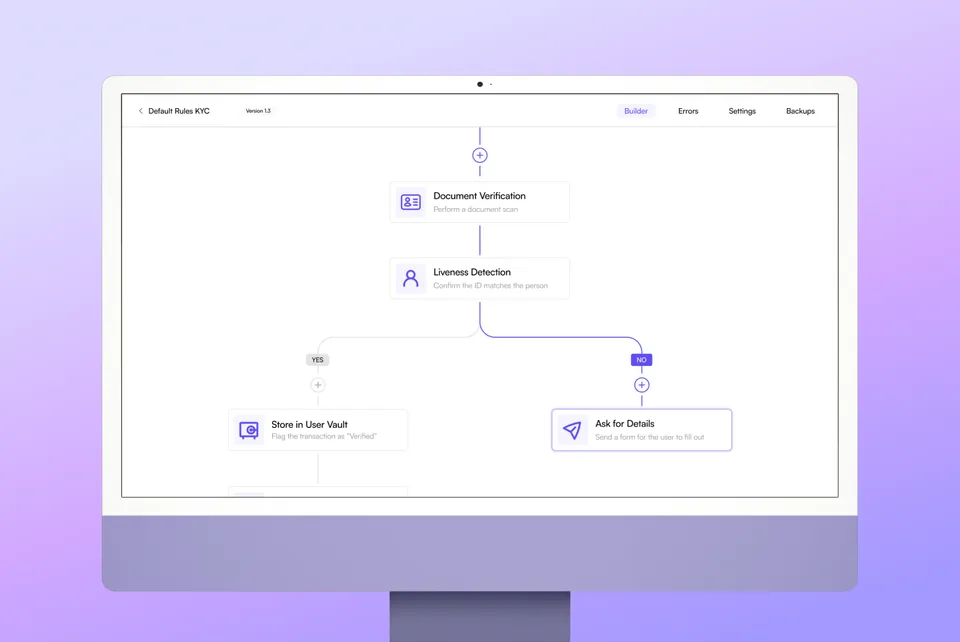
The process begins when a user submits personal identification documents—such as a passport or driver’s license—to a trusted issuer. Leading providers like Entrust or Dock verify the authenticity of these documents against official government databases. Once validated, the issuer signs a Verifiable Credential (VC), a cryptographically secured digital record that attests to the user's identity. This step establishes the "golden copy" of the client data, ensuring accuracy and preventing the need for repetitive data entry.
The user receives the signed Verifiable Credential and stores it securely within their decentralized KYC vault. Unlike traditional databases, this vault is often a self-sovereign identity wallet that gives the user full control over their data. The credential remains encrypted and private, accessible only by the user. This separation of storage from verification is critical; the verifier never sees the underlying raw data, only the proof that the user possesses a valid credential.
When a regulated entity needs to verify the user, the vault generates a zero-knowledge proof (ZKP). This cryptographic method allows the user to prove they meet specific criteria—such as being over 18 or residing in a permitted jurisdiction—without revealing the underlying personal details. The verifier checks the proof against the issuer's public key. If valid, access is granted. This approach aligns with the principles of decentralized KYC, where institutions sync data to guarantee a single source of truth while maintaining strict user privacy.
Navigating AML and KYC Regulations
Building a Decentralized KYC Vaults guide for regulated markets requires more than just secure storage; it demands a system that satisfies strict legal obligations like GDPR and MiCA. Traditional KYC processes often create data silos, but decentralized identity models solve this by allowing institutions to share verified credentials without exposing raw personal data. This approach ensures that a "golden copy" of client data is maintained across the network, keeping information up-to-date while eradicating duplicates and reducing fraud risks.
Selective disclosure is the cornerstone of compliance in this space. Instead of handing over entire identity documents, users can prove specific attributes—such as being over 18 or passing a sanctions check—without revealing their full name or address. This granular control aligns with the data minimization principles required by European regulations, allowing banks to verify identity securely while protecting user privacy. Systems like those offered by Entrust demonstrate how decentralized identity can help financial institutions meet these challenges cost-effectively.
Audit trails and verifiable credentials provide the necessary transparency for regulators. Every verification event is recorded on-chain or in a secure ledger, creating an immutable history that auditors can access without compromising the underlying data. This ensures that institutions can demonstrate compliance with Anti-Money Laundering (AML) directives in real-time. By integrating these mechanisms, platforms can onboard users securely while maintaining the trust required by high-stakes financial regulators.
Integrating Decentralized KYC into your stack
Adopting decentralized KYC vaults requires shifting from a centralized data model to a user-centric verification architecture. This guide provides a practical checklist for developers and compliance officers to implement this infrastructure correctly, drawing on standards from providers like Entrust and IntellectEU.
1. Select a DID Framework
Choose a Decentralized Identifier (DID) method that aligns with your jurisdiction’s regulatory requirements. The framework must support verifiable credentials (VCs) and allow for revocation checks. IntellectEU emphasizes that a single "golden copy" of client data must be maintained across the network to prevent duplicates while ensuring data is up-to-date.
2. Choose a ZK Proof Provider
Integrate a zero-knowledge (ZK) provider to enable privacy-preserving proofs. Instead of sending raw PII to verifiers, the vault generates a cryptographic proof that the user meets specific criteria (e.g., age > 18, not on a sanctions list). Entrust and Dock offer robust SDKs for generating these proofs, ensuring that sensitive data never leaves the user’s device.
3. Define Verification Rules
Map your compliance requirements to specific ZK circuits. Define exactly which attributes need to be proven and which can remain private. This step is critical for balancing regulatory scrutiny with user privacy. Ensure your verifier can independently validate the ZK proof against the issuer’s public key.
4. Test Privacy Guarantees
Before going live, conduct rigorous penetration testing on your verification flow. Verify that no metadata leaks occur during the proof generation or verification process. Use tools to simulate adversarial verifiers attempting to extract PII from the proof data. Ensure that the vault correctly handles credential revocation events in real-time.
No comments yet. Be the first to share your thoughts!