Why traditional KYC fails Web3
The current identity verification model is a structural mismatch for decentralized finance. Traditional KYC relies on centralized databases where users upload sensitive documents—passports, selfies, and proof of address—to a single third-party provider. This architecture creates a honeypot for malicious actors. When a centralized verification firm is breached, the consequences are catastrophic. Every piece of PII (Personally Identifiable Information) stored in that database is compromised, leaving users with no recourse.
Beyond security, centralized KYC violates the core privacy norms of Web3. In a blockchain ecosystem, identity should be self-sovereign. Users should control their credentials and share only what is necessary for compliance, not surrender their entire identity history to a corporate database. Traditional systems force users to trust intermediaries with their data, creating single points of failure that contradict the decentralized ethos of Web3.
A decentralized KYC vault guide is essential because it offers an alternative: an architecture where identity data is split across user-controlled credentials and verified through zero-knowledge proofs. This approach allows institutions to confirm compliance without storing sensitive documents, eliminating the honeypot risk while preserving user privacy.
How decentralized KYC vaults work
A decentralized KYC vault turns identity verification into a user-controlled process. Instead of handing over your passport or driver’s license to a central database, you keep your credentials in a secure digital vault on your device. This shift moves the burden of data storage away from institutions and back to the individual, reducing the attack surface for massive data breaches.
The magic happens with zero-knowledge proofs (ZKPs). This cryptographic method allows you to prove you meet specific criteria without revealing the underlying data. For example, you can prove you are over 18 without disclosing your exact birthdate or address. The verification happens off-chain, ensuring your sensitive personal information never touches the public blockchain.
To bridge the gap between your private vault and the public ledger, decentralized oracles act as trusted intermediaries. These oracles verify the authenticity of your credentials from a recognized issuer and then relay a simple "verified" signal to the smart contract. This on-chain proof confirms your identity status to the dApp or service without exposing your actual identity details.
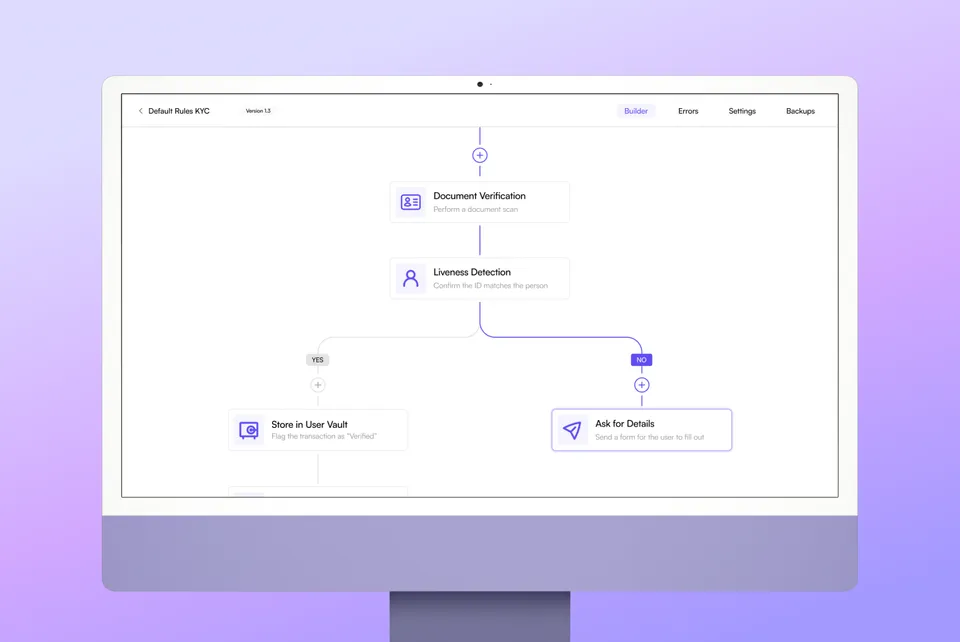
This architecture creates a secure, privacy-preserving framework for financial institutions and Web3 platforms. By splitting identity data across user-controlled credentials and ZKPs, the system simplifies onboarding while maintaining strict compliance. You retain ownership of your data, and services only receive the minimum necessary proof for verification.
The infrastructure stack powering decentralized KYC vaults
A decentralized KYC vault doesn’t work in isolation. It relies on a specific stack of tools to verify identity without exposing raw data. This architecture bridges traditional compliance requirements with Web3 privacy standards. The core components are DID providers, zero-knowledge circuits, and oracle networks.
DID providers and issuer standards
Decentralized Identifiers (DIDs) create the unique, portable identity records that vaults manage. DID providers like Dock and Didit offer the infrastructure to issue and verify these credentials. They ensure that identity data remains under user control while remaining verifiable by third parties. This is foundational for any decentralized KYC vault guide, as it replaces centralized databases with user-owned keys.
Zero-knowledge proof circuits
Zero-knowledge (ZK) circuits are the privacy engine of the vault. They allow a user to prove they meet a criteria—such as being over 18 or passing a sanctions check—without revealing their birthdate or name. This cryptographic layer ensures that the vault only stores and transmits proof, not personal identifiable information (PII).
Oracle networks for on-chain verification
Oracles bridge the gap between off-chain identity verification and on-chain smart contracts. They fetch the latest KYC status from the DID provider and relay it to the blockchain. This real-time data feed allows applications to enforce compliance rules automatically, ensuring that only verified users can interact with specific protocols.
Comparing infrastructure providers
Different providers offer varying levels of ZK support and compliance integration. The table below compares key players in the decentralized identity space.
| Provider | ZK Support | Compliance Focus | Integration Type |
|---|---|---|---|
| Dock | Native | GDPR/CCPA | SDK/API |
| Didit | Advanced | Global KYC | Web3 Wallets |
| IDmerit | Limited | Enterprise | Legacy Systems |
| Polygon ID | Native | EVM-based | Smart Contracts |
Compliance and regulatory strategy
Building a decentralized KYC vault guide that satisfies MiCA, FATF, and GDPR requires a shift from central storage to cryptographic proof. Regulators do not care about your architecture; they care about auditability, data minimization, and the right to be forgotten. Your vault must act as a compliance engine, not just a storage locker.
MiCA demands strict identity verification without exposing unnecessary personal data. Use zero-knowledge proofs (ZKPs) to generate cryptographic evidence that a user meets age, residency, or accreditation requirements. This allows you to prove compliance to regulators without storing the underlying passport scan or birth certificate in your database. The proof is verifiable on-chain, but the data remains private.

GDPR’s right to erasure is difficult in immutable systems. Solve this by storing only encrypted hashes or ZK-proof references on the blockchain, while keeping the raw PII in an off-chain, encrypted vault. When a user exercises their right to be forgotten, you delete the decryption key. The on-chain record becomes cryptographically useless, effectively erasing the data while maintaining the audit trail of the deletion event.
The FATF Travel Rule requires financial institutions to share originator and beneficiary information. Your vault should log every verification event, key access, and proof generation as an immutable transaction. This creates a tamper-proof audit trail that satisfies anti-money laundering (AML) examiners. Ensure these logs are structured to be easily exportable for regulatory review.
Market trends and adoption signals
The sector is moving from experimental pilots to structured compliance frameworks. Adoption is no longer driven solely by privacy advocates; regulated financial institutions are integrating these vaults to manage identity data without holding sensitive records themselves. This shift reduces liability and simplifies onboarding for users across borders.
Growth signals are visible in the infrastructure layer. As blockchain KYC evolves, the focus is shifting toward interoperable standards that allow a verified credential to be reused across multiple platforms. This utility is driving demand for solutions that balance regulatory transparency with zero-knowledge proofs.
The market trajectory suggests a consolidation of providers who can offer both technical robustness and legal clarity. Institutions are prioritizing vendors who demonstrate clear audit trails and compliance with emerging data protection laws. This environment favors decentralized KYC vaults that act as neutral, secure repositories for identity verification.
Common questions about vault security
Users often worry about how decentralized KYC vaults handle sensitive data. The architecture relies on zero-knowledge proofs and distributed ledger technology to ensure that identity verification happens without exposing raw personal information to a central authority. This approach balances regulatory compliance with user privacy.
Helpful gear
Use these product recommendations as a starting point, then choose the size, material, and price point that fit how you actually use the gear.



As an Amazon Associate, we may earn from qualifying purchases.
No comments yet. Be the first to share your thoughts!