What decentralized KYC vaults infrastructure means
A Decentralized KYC vault is a user-owned credential store that shifts personal data from centralized company databases into private, verifiable containers. Instead of handing your passport or driver’s license to every financial institution you interact with, you hold the cryptographic proof of your identity in a digital vault you control.
This model pairs AI verification agents with a substrate that eliminates the need for institutions to store your personally identifiable information (PII). When a bank or crypto exchange needs to verify you, they request a specific claim—such as "over 18" or "passed AML check"—rather than your entire identity file. You grant permission, and the vault provides a cryptographically signed verification.
The trade-off here is between privacy and regulatory compliance. Traditional centralized databases are easy for regulators to subpoena but vulnerable to massive breaches. Decentralized vaults protect user privacy by design but require robust identity frameworks to ensure that the credentials issued are trusted by financial regulators. The goal is a system where compliance is verified without exposing the underlying data.
This infrastructure relies on verifiable credentials issued by trusted authorities. As noted in industry analyses, decentralized KYC allows customers to be issued credentials that can be cryptographically verified and stored securely, ensuring that data sharing is both efficient and compliant with evolving legal standards.
How verification agents and oracles bridge identity
Decentralized KYC Vault infrastructure relies on a specific handshake between off-chain verification and on-chain settlement. The process ensures that identity claims are validated without exposing personally identifiable information (PII) to the public ledger. This mechanism allows platforms to comply with regulatory standards while maintaining user privacy.
1. AI Agents Verify Off-Chain Data
The process begins with AI verification agents interacting with the user’s local device or secure off-chain storage. These agents analyze documents such as passports or utility bills. Instead of uploading the raw image to the blockchain, the agent extracts specific data points. It then generates a cryptographic proof that the document is authentic and the data matches the claimed identity. This step keeps sensitive PII off the public network entirely.
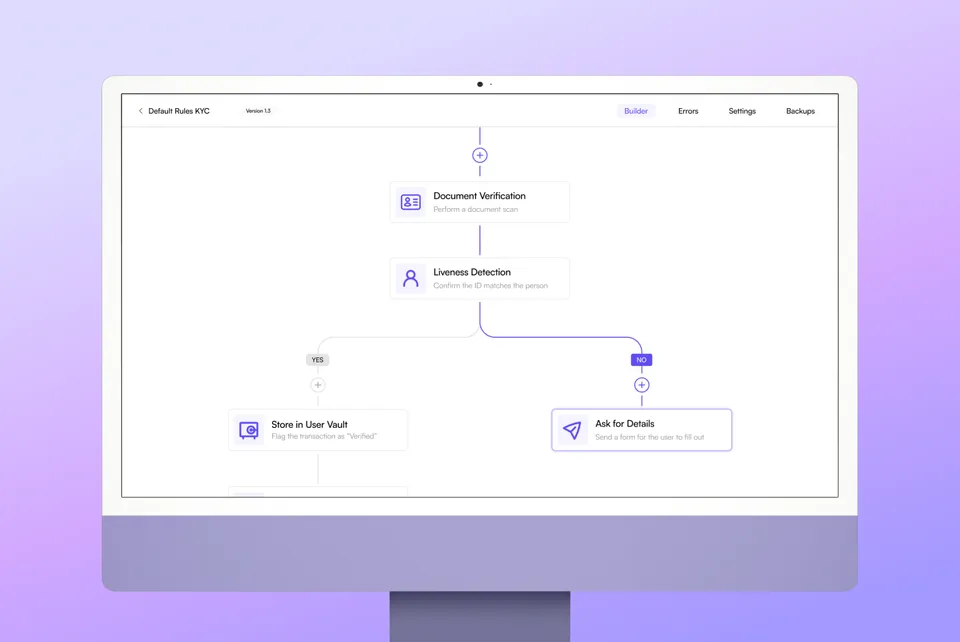
AI agents analyze off-chain documents to generate cryptographic proofs of authenticity without exposing raw PII to the public network.
2. Zero-Knowledge Proofs Generate Credentials
Once the AI agent validates the data, it creates a zero-knowledge proof (ZKP). This mathematical proof demonstrates that the user meets specific criteria—such as being over 18, passing a sanctions check, or holding a valid license—without revealing the underlying data. For example, a ZKP can prove "age > 18" without disclosing the exact birth date. This credential is the core asset that will eventually be stored or referenced in the decentralized KYC vault.

Zero-knowledge proofs allow users to prove compliance criteria like age or residency without revealing the underlying personal data on-chain.
3. Oracles Bridge On-Chain and Off-Chain
Decentralized oracles act as the trusted bridge between the off-chain verification result and the on-chain vault. The oracle fetches the status of the ZKP or the verification agent’s attestation. It then writes this status to the blockchain in a standardized format. This step ensures that smart contracts can reliably read the verification status without needing to trust a single centralized entity. The oracle essentially translates the off-chain "verified" state into an on-chain signal.
Oracles translate off-chain verification results into on-chain signals, allowing smart contracts to trustlessly read compliance status.
4. On-Chain Vaults Store Attestations
The final step involves storing the attestation in a decentralized KYC vault. Rather than storing the PII, the vault stores the hash of the ZKP or the oracle’s signed attestation. This creates a portable, reusable credential. When a user interacts with a new platform, they can present this on-chain proof. The platform’s smart contract verifies the proof against the vault, confirming compliance without needing to re-verify the user’s documents.

Decentralized KYC Vaults store cryptographic attestations, creating portable credentials that platforms can verify without re-collecting PII.
This architecture transforms identity from a static document into a dynamic, verifiable asset. By separating the data from the proof, decentralized KYC vaults enable compliance at scale while respecting privacy regulations.
| Component | Role | Data Handling |
|---|---|---|
| AI Agent | Verification | Off-chain analysis |
| ZKP | Proof Generation | Zero-knowledge |
| Oracle | Bridge | Status relay |
| Vault | Storage | Attestation hash |
Market analysis of compliance and reputation layers
The shift toward a Decentralized KYC Vaults guide reflects a broader economic correction in how institutions handle identity data. Traditional providers operate on a centralized ledger model, where every check creates a new data silo. This creates redundant costs and compounding security risks. As regulatory pressure mounts, the economic argument for decentralized infrastructure becomes clearer: it reduces duplication while maintaining auditability.
Institutional adoption is no longer theoretical. Major financial entities are moving from pilot programs to production environments. For example, Intellect Design Arena’s Catalyst Blockchain Manager demonstrates how decentralized systems can sync data across institutions to guarantee a single, golden copy of client information. This approach eliminates the friction of re-verifying the same natural persons across different banking partners. The result is a streamlined compliance workflow that respects privacy while satisfying regulatory scrutiny.
To understand the economic drivers, we must compare the operational realities of centralized versus decentralized models. The table below outlines the core differences in cost structure, privacy architecture, and compliance scope.
| Feature | Traditional KYC | Decentralized Vault |
|---|---|---|
| Data Storage | Centralized silos | Distributed ledger |
| Verification Cost | High (redundant checks) | Lower (shared truth) |
| Privacy Model | Provider-controlled | User-controlled |
| Audit Trail | Internal logs | Immutable public record |
The economic incentive for this transition is driven by risk mitigation. In a decentralized vault, the user holds the key to their identity data. Institutions access only the necessary credentials via zero-knowledge proofs, rather than raw personal data. This reduces the liability of data breaches and simplifies compliance with evolving regulations like GDPR and MiCA. The market is consolidating around providers who can offer this balance of efficiency and security, making decentralized identity the standard for high-stakes regulatory environments.
Implementing vaults for regulatory compliance
Integrating decentralized KYC vaults into your existing compliance workflows requires a shift from centralized data hoarding to cryptographic proof. For legal and regulatory teams, the goal is maintaining auditability while enforcing strict data minimization. This approach satisfies Know Your Customer (KYC) requirements without exposing sensitive personal information to unnecessary risk.
Step 1: Map Existing Compliance Requirements
Begin by auditing your current onboarding and transaction monitoring workflows. Identify exactly which data points—such as government ID numbers, biometric hashes, or proof of address—are legally required versus those that are merely convenient. Decentralized KYC vaults work best when you isolate only the mandatory fields. This mapping exercise ensures that your vault architecture is built around specific regulatory obligations rather than generic data collection habits.
Step 2: Select a Verifiable Credential Standard
Choose a standard for issuing and verifying credentials, such as W3C Verifiable Credentials or ISO/IEC 18013-5 mobile ID standards. The standard must support zero-knowledge proofs (ZKPs) or similar cryptographic methods that allow users to prove attributes (e.g., "over 18") without revealing the underlying data. This step is critical for maintaining user privacy while providing regulators with mathematically verifiable proof of compliance.
Step 3: Integrate Vault APIs with Your Backend
Connect your internal compliance systems to the decentralized identity provider’s API. Instead of storing raw user data in your database, your system should request a signed credential from the vault. Implement logic to verify the cryptographic signature and validate the credential’s status against the issuer’s revocation list. This integration ensures that your systems only hold the minimal proof required for each transaction or onboarding event.
Step 4: Establish Audit Trails and Monitoring
Decentralized systems still require robust internal logging for regulatory audits. Configure your system to log verification events, credential issuance times, and revocation checks without storing the underlying personal data. These logs serve as your audit trail, demonstrating to regulators that you have performed due diligence. Ensure these logs are immutable and timestamped to withstand regulatory scrutiny.
Step 5: Conduct Privacy Impact Assessments
Before full deployment, conduct a Privacy Impact Assessment (PIA) to evaluate how the vault handles data. Verify that the implementation adheres to GDPR, CCPA, or other relevant data protection laws. Test the system to ensure that no residual personal data leaks from the verification process. This step protects your institution from liability and builds trust with users who are increasingly concerned about data privacy.
Step 6: Train Compliance and Legal Teams
Your legal and compliance teams need to understand how decentralized verification works. Train them to interpret zero-knowledge proofs and understand the legal weight of cryptographic attestations. They must be able to explain to regulators why a hash-based proof is equivalent to a scanned ID document. This education is vital for defending your compliance posture during audits or regulatory examinations.
No comments yet. Be the first to share your thoughts!